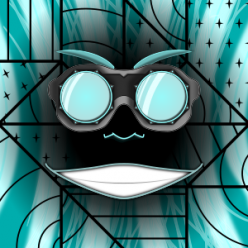
edited by Ziv Wities
.3.
At this age, on the planet of Orvalho, Alberto is conjoined with the ship called The Offer of Peace Between Two Worlds. They’re engulfed in the Mezelões’ unifying mix, a tank where a swirling brackish secretion flows through their pores and recesses, nanoscopic spidery bots tying their espírito together—parts and limbs, yottabytes and nucleotides, ship and captain, physically separated, spiritually united.
When they leave the tank, dripping dark goo, crying and whirring, they have become one, bound to each other.
Alberto is a child: gaunt, dark-skinned, green-eyed; born to be a captain. He’ll soon contest that, like all the people who are born and bound to be anything by those who came before them.
The Offer of Peace Between Two Worlds is a ship: silvery, slender, streamlined; born to be an offer. It looks like a toy—for Alberto, it is one, though he’ll soon stop seeing it that way. It’s a tiny spaceship with a prow; dronelike, smaller than a goose. When charged, the engine it was born with lets it cross from the kitchen to the garden without needing extra fusion cells.
Weeks after crying in despair in the Mezelões’ labs, Alberto shyly learns to giggle into the loneliness of his wide bedroom, constructed to give space to child and ship. In between visits from his allocated guardians, Alberto learns to play with The Offer of Peace Between Two Worlds. He taps its gleaming hull and the ship hurtles through the bedroom. When the window is open, it swishes out and returns many minutes later, dripping on rainy days, sizzling on the hot ones. Alberto calls it Offy. At night, Alberto learns to smile at Offy, but never to kiss it good night. No one has taught him about kisses. Offy turns down its engines so Alberto can sleep. Turns them down, that is, until it learns that Alberto prefers its whirs and hums, and the soft white lights of its protruding mole-like bridge.
.10.
At this age, Alberto resents every time he hears the Mezelões calling Offy by other names—”The Offer of Peace Between Two Worlds”, “a nurturing investment”, “the shot at peace for the galaxy”, “a gift for the enemy”. For Alberto, it’ll always be Offy. Offy can’t express it yet—its mindstream system isn’t fully grown—but it can feel Alberto’s annoyance when grownups call him “little captain”, “brother of the offer”, “bringer of peace”. For Alberto, the word ‘brother’ seems misplaced, and one day he’ll understand why.
Offy is bigger than a tricycle now and growing every day, its gobbling drive devouring the raw material the guardians leave for it—steel, titanium, magnesium, and an entire bevy of alloys and mixtures carefully nurtured for ship growth. Alberto barely fits inside, occupying most of its payload. He’s free to fly it, his guardians say, though they’re still bounded by the limits of the Captain’s Dome, which comprises his bedroom and the guardians’ annex. Alberto hates limits. He wants to break away from Orvalho and fly to the twinkling stars, home of a hundred races, of a thousand planets, of a million cities. The grownups say he’ll be able to go wherever he wants one day, when he’s captain, when The Offer of Peace Between Two Worlds is fully matured.
On some nights, Alberto has nightmares. In them, he’s back in the Mezelões’ tanks. But instead of a union, he’s being separated from Offy, with freezing, brackish goo pouring out of his body. He cries, restless, trying to swim, looking for Offy. But before he finds it, Offy—the real one, from the waking world—flies closer to him, whirring a bit louder. It’s only then Alberto knows he won’t drown.
.15.
At this age, Alberto’s guardians give Offy its first hangar. It’s a spacious building outside the Captain’s Dome, reeking of oil, iron, and disinfectant. Offy is still only a dot inside it, the size of two trucks, but its mindstream system is grown now. The first words it conveys to Alberto are: “I want to fly higher.”
“You will,” Alberto whispers, cheeks plastered against Offy’s hull. “We will.”
Alberto’s free now, the guardians tell him, and he can fly Offy whenever he wants. Offy, however, is leashed. It pains Alberto when he finds out about the coercive routine they have installed to prevent Offy from traveling further than Orvalho’s orbit. After five nights with Offy mindstreaming its data to Alberto, he learns how to override it.
.16.
At this age, Alberto identifies one of the many things that bother him. She hates to be called “he”. Offy realizes one thing as well. They hate to be called “it”.
Offy now has a set of skintight suits for EVA activities, a small rover, and a robust sub-light engine that performs at 0.001c. So Alberto breaks the rules and flies Offy to Beirão, Orvalho’s biggest moon. There, she wears a suit and walks out. She does things she always wanted: hop in the moon’s weak gravity; allow her feet to leave marks on the regolith; stare at the pearlescent surface of Orvalho for an hour. Finally, she talks. With their nose pointing up, Offy listens.
“I know what you are, what you were created to be. An offer of peace. You’re to be given to the Indaleões so the war between them and the Mezelões, two centuries long, can finally end. They bred you through me, tied our espíritos, because that’s the only way a ship can be. But they don’t mean for us to stay together like conjoined captains are supposed to. No, they’ll separate us so you can be a gift to some other people. Your own name means that. Then they’ll use you in their exhibitions or worse—forcefully tie you to a new captain. It will be painful for you and for me. They know it too, but they don’t care. Offy… I don’t intend to let that happen.”
But then, how many things have to happen, irrespective of what one wants?
.20.
At this age, Alia and Offy have their first fight. It is hardly an even match; in the last few years, as acne pockmarked Alia’s cheeks, Offy grew their core weapons—two laser cannons, an electron beam, internal coupled guns, and a series of hull turrets. But they turn none of it against Alia, even though she scowls at them, seething, thrashing the bridge’s comm panels and terminals, trying uselessly to crack their glass panes. Eventually, she surrenders and crashes into a couch, weeping and bristling as she absorbs everything Offy has mindstreamed to her. Offy wants to leave. Of their own accord, they want to go and explore the galaxy on their own.
When Alia tries to infiltrate Offy’s code and override it—like she did so many times to invisibly counter the Mezelões’ meddling—a terrible wind knocks her to the ground, and in strong gusts flowing along Offy’s corridors, it swooshes her away through an airlock. She stumbles out into the hangar as Offy activates their drive and flies away.
She’s left incomplete.
.22.
At this age, Alia lives alone in a shipping container with three ore miners. Without The Offer of Peace Between Two Worlds, she’s no longer a captain, no longer relevant to the Mezelões. Her guardians of childhood, once all smiles and gifts and kind words, are never to be seen again.
The fact that The Offer of Peace Between Two Worlds fled doesn’t mean they lost their conjoined espíritos. Instead, it means Alia lost part of her soul. She lives restlessly. Day after day, she’s wearier, gaunter, her eyes drooping, her hair falling. She obsesses over the ship’s operation logs, streaming them over and over in her mind. And, one day, barely eating anymore, she finally decrypts a set of logs from their last days together. The Offer of Peace Between Two Worlds didn’t leave because they wanted to be free—as they had every right to want—but because they feared Alia would suffer, or even be disposed of, when Offy had to finally become an offer to the Indaleões.
Alia decides to draw momentum and energy from the logs, like a fusion drive thirsty for deuterium. She hitchhikes on an ore miner, then hops to a rock trawler, crosses warp gates between systems. She lives off begging, and degrading jobs, and stealing. All the while, searching for the signature of The Offer of Peace Between Two Worlds—Offy; their name is Offy.
.24.
At this age, she does find Offy. Using a rock trawler’s detection system, yes, but she also feels it somewhere within her, her espírito bubbling up. Something clicks within her, like a puzzle piece falling into place.
Offy’s orbiting a gas giant, their hull reflecting a dismal blueish light. Around them, five Mezelões blastships order Offy’s surrender. Alia watches it all from the rock trawler’s skiff she stole, zooming on the battle scene, listening to public broadcasts being transmitted from within the fray. It’s the first time she sees Offy using their weapons and she takes pride in their use: the electron beam ripping off the Mezelões’ hulls, the turrets exploding their skiffs and drones. And as she finds strength in seeing Offy again, they find it nurturing to feel Alia once more, less than 1 AU off. That’s when Offy uses their laser cannons at full potential and disintegrates the remaining Mezelões ships.
When they reunite, it’s like finding a rose intact on a bloody battlefield.
.27.
At this age, rebels die. Alia doesn’t. She’s the first of the Mezelões’ captains to defect. With Offy, she spends her time hopping from system to system as Offy’s camouflage system grows and their gobbling drive feeds off any matter it can find on asteroids and rocky planets. They finally reach their full size, large enough to house 3,000 people—room for every soldier in the Indaleões’ primary fleet. But Offy needs no one but Alia to control its subsystems, from the churning particles of the budding FTL drive to the life support system’s sighs of oxygen. And the pair travel through the galaxy, their only aim, to be anything but a captain and to be anything but an offer, ignoring all the broadcasts the Mezelões direct at them: you can’t be.
.30.
At this age, the duo is the most valuable asset in the galaxy. In the eyes of the Mezelões, Offy is a fully-formed offer, but it’s more than that. Their separation and eventual reunion made Offy develop faster than expected. Their hull has grown another layer of titanium; their FTL drive, usually fully developed only at 60 years from conjoining, is almost at its prime; their weapons offer twice as much firepower as a similar ship would at this age.
And in the Mezelões’ eyes, Alia, despite being a rebel and a wanted woman, is a splendid captain, capable of controlling—though Alia hates the word—all of Offy’s systems with mere slivers of mindstreamed thoughts, without needing to couple herself to chairs and machinery like other captains.
And that’s why they’re chased. Their life becomes fleeing, surviving, hiding in the solitary caves of unexplored moons, orbiting uncharted gas giants, free-floating in the blackness of interstellar space. At times, Alia finds herself disguised, roaming the infinite streets of ultra-dense cities, disappearing amongst ten billion citizens. Offy finds themself changing their drive signature and exhaust patterns day after day. Offy develops a factory of replicating bots and, with the bots’ help, learns to shapeshift. One day, they look like a cigarette. Another day, they’re in the form of a turtle swimming across the void.
One of those days, Alia and Offy wonder if they’re forever.
.45.
At this age, light becomes slower. Offy develops a fully-formed FTL drive. Though at this point, Alia and Offy don’t see each other as conjoined entities anymore. They’re simply one, and they call themself Alyof.
Going faster than light, Alyof can reach other galaxies, transforming the Mezelões, the Indaleões, and their pitiful skirmish into something as irrelevant as a molecule lost in the vacuum. Some of their most formidable ships, conjoined with their wisest and oldest captains, can still reach them. But not many dare to defy Alyof anymore. By now, they have a plethora of planet-wrecking weapons that no ship has ever achieved. Alyof becomes a mere anomalous curiosity, a feature of space to be observed and respected from a distance, like a quasar.
.85.
At this age, Alyof learns they’re not invincible. Not because the Mezelões develop a fleet to chase Alyof, although they do and they’re utterly destroyed; not because a race of vacuum-traveling stingrays tries to absorb Alyof into their being, although they do and they’re repelled. But because their espírito can still break.
What was once Alia longs for rest. Tethered to the bridge by a cobweb of flesh, what was once Alia wheezes, coughs, and dozes off. At times, what was once Alia misses things it would never believe it would miss: the soft bedsheets of a bedroom; a cup of coffee in a silent cantina; a walk to an observation deck to watch a terraformed forest slowly growing; the touch of someone’s hand.
What was once Offy longs for more. It wants to explore the corners of the universe, to know, to learn, to never cease to be. At times, what was once Offy longs for things it would never believe it would long for: to fly closer to black holes, to visit the frontiers of the known universe, to observe species evolving from their puddles to their pyramids.
For what was once Alia, what was once Offy becomes a weight.
For what was once Offy, what was once Alia becomes a tumor.
In the end, Alyof realizes they can’t be.
And this is how a spirit breaks: on a chalky, cold planet, Alyof expels Alia from their guts and becomes Offy again. Naked and wrinkly, gasping, with fleshy knobs hanging from her body, Alia curls on the ground, dwarfed by Offy like a discarded offer given to a deserted world. She raises a hand to them but has to close her eyes.
Alia never sees when Offy turns into a blue dot in the sky. She feels something in her chest that she mistakes for pain, but it’s only longing for what was once part of her.
.1,263.
At this age and every age beyond that, Offy travels. Cruising between two galaxies a thousand times faster than light, Offy listens to one who was once part of them. Offy knows they’ll never be whole again, but they can pretend. The reconstructed voice talks through their speakers and writes to their logs in a rough imitation of mindstreaming processes.
“I’m still afraid I’ll have to die one day and leave you,” the voice says. “My body is not like yours.”
Offy whirs a bit louder so that unreal part of them knows they can’t drown and they can be.
© 2024 by Renan Bernardo
2484 words
Author’s Note: The idea of a deep relationship between a spaceship and its captain has been on my mind for a long while. I’ve published a story of a man who tethers himself to an FTL drive, but I also thought of something far deeper than that, more organic. Then I came up with this idea of a society of captains that are conjoined with their spaceships and whose relationship needs to thrive for the spaceship to fully mature. But as with all relationships, it has its price.
Renan Bernardo is a science fiction and fantasy writer from Rio de Janeiro, Brazil. His fiction appeared in or is forthcoming from Tor.com, Apex Magazine, PodCastle, Escape Pod, Daily Science Fiction, Samovar, Solarpunk Magazine, and others. His writing scope is broad, from secondary-world fantasy to dark science fiction, but he enjoys the intersection of climate narratives with science, technology, and the human relations inherent to it. His solarpunk/cli-fi short fiction collection, Different Kinds of Defiance (Android Press) is forthcoming on March 26th, 2024. His fiction has also appeared in multiple languages, including German, Italian, Japanese, and Portuguese.
If you enjoyed the story you might also want to visit our Support Page, or read the other story offerings.