Content note (click for details)
oppression of marginalized groups, references to self-harmedited by David Steffen
The antler people are exceedingly rare, but I’ve made sure my daughter knows about them. Not just as myth or stereotype, but as people like any others. Anyone could be an antler person, and if the velvety nubs of little antlers ever start to poke through her hair, I want her to greet them with ease, acceptance, maybe even joy.
When I cut my daughter’s hair, running my fingers through the dark locks and over her scalp, I’m vigilant for the faintest ridge or bump that might be the beginning of rising bone. I never feel it and I know I probably never will, but if it comes, I want to share in that moment of discovery. What does any parent want more than to share in their child’s growth? It’s why I cut her hair: to help her experiment with different styles, different ways of presenting herself, different possibilities of who she could choose to be.
There’s a closeness in it, in working with another’s hair, watching each other’s reflections in the mirror and talking about anything. I’ve been cutting my own hair since I was her age, but that isn’t the same, and I’m beginning to suspect that the day might not be far away that she asks me to show her how to cut her hair herself. She’s been quiet recently, and she hides her eyes down in her phone, and she leaps away the second I say I’m done.
***
I’ve only ever once met an antler person. They were leaving the adoption agency as I was on my way in for an interview. They wore a wide-brimmed hat that hid what they were and made them unremarkable, but they walked with a slow, heartbroken aimlessness that made me stop and ask if they were alright.
“Denied,” they said. “Third time. Dunno if I’ve got another one in me.”
“Oh,” I said, insides fluttering for my own hopes of adopting. “Is it that hard?”
Their lips smiled and eyes glistened. They took the brim of their hat in two fingers and lifted it just enough to show me the slender, forked antlers that rose from their scalp and swept back over their hair. Small things, much smaller than the sensational pictures I’d seen of old antler people whose antlers reached their armspan and nearly doubled their height with fingerprint patterns of branching bone, but unmistakable.
Then they looked at me, at my perfectly cut bob of short hair upon a smooth skull, and said, “Shouldn’t be hard for you.”
I wish I had asked them—anything. Everything. But I was too shocked to get out any words, and then they were gone.
I brought my daughter home two months later.
***
Things are changing, slowly. You see antler people on TV sometimes now, hear trivia about them in gossip. Did you know sometimes they shed their antlers and grow a new pair? Did you know they used to be revered in some far away, long ago culture? Always far enough away and long enough ago that we could laugh at it, how ridiculous, but at least it is laughter now, and curiosity, as often as fear or disgust or denial.
There are more of them in my daughter’s generation than ever before, displaying their antlers with pride and defiance. It makes me happy for them.
My daughter’s style is drifting toward the proud and defiant. Taking cues from her girlfriend, I think: oversize flannels, patches and buttons that range from cute smiling vegetables to bold political statements. I won’t bend on the piercings rule—nothing but ears until she’s sixteen—but I yield on hair dye. She picks a lovely shade of plum purple, and we stumble our way through the process of bleaching and dying.
As I’m massaging the color into her roots, I say, “You’ve been quiet. Is everything okay?”
She hesitates long enough before saying, “Yeah, fine,” that I know it isn’t true.
***
I don’t press, but I tell her I know something is wrong and that I’m there.
In time, she says, “I think I need your help with something.” She bites her lip when I ask what, and says, “Swear you won’t tell anyone.”
“I swear.”
She shrugs out of her baggy oversize flannel shirt and pulls off the t-shirt under it. She’s wrapped compression bandages around her chest, and my first thought is that she—he?—could be trans. My second is that we’ll have to get binders right away, something safer than those bandages.
Then she turns her back to me and unwraps them.
Wings.
She has wings.
“Oh my god,” I whisper. I’ve never seen anything like it.
They’re small yet, and the feathers—deep, glossy brown-black just a shade darker than her hair was before we dyed it—are crumpled from being held down.
“I don’t know how to get rid of them,” she says, and her voice cracks a little, and so does my heart.
“You don’t have to,” I tell her.
“But they keep growing. I don’t know how much longer I can hide them.”
“You don’t have to,” I say again.
“People don’t have wings, mom!” she shouts, turning to face me with her shirts and bandages bundled up against her chest. Her wings open wide behind her. “Something is wrong with me!”
No, no no no. What do I say?
“I need to get rid of them,” she says. “I just want to go back to normal.”
“Look at me. I—” Words aren’t enough. “Look.”
I reach up into my hair, so carefully cut and arranged, to find the reason I started cutting it myself, the thing that I couldn’t let anyone else ever see. I part my hair just so, and show my daughter the scars.
“You’re…” she says. “I don’t get it. Why didn’t you…? What happened?”
“They started coming in when I was your age. I had never even heard of antler people. I tried to ask people about it—my parents, teachers, total strangers, even—always just hypothetical. What if someone started growing little horns on their head? I didn’t even know they were antlers! But every answer I got was either that that wasn’t real or that it would be monstrous. So I—”
I don’t tell her everything. I don’t tell her how I spent months planning it, to make sure I wouldn’t hurt myself too badly and wouldn’t get caught. I don’t tell her how long it took to saw through them, sobbing and cursing because it hurt so much, and because I was terrified that it was taking too long and my parents would get home before I could finish and clean up all the blood.
I don’t tell her how, a week later, there were new nubs of antler growing out of the wounds, and I had to cut them off three times each before they stopped trying to grow back.
But I do tell her that there is nothing in the world I regret so much.
***
“That’s different,” she says. “That’s antlers. Of course people can have antlers. But not—”
“Of course people can have wings,” I tell her, with absolute conviction. “You know how I know? Because you do.” I cup her face in my hands and say, “Imagine if you let them grow enough to fly.”
When she breaks down crying, I want to ask how long she’s been holding this. But I don’t. She doesn’t have to tell me everything. I just hold her, stroking her hair and promising that she’ll be okay.
***
I didn’t learn about antler people until years after I’d cut mine away. When I did, I didn’t know what to feel. There was relief, to know I wasn’t the only one. There was fear, because you couldn’t learn about antler people without learning how the world treated them. But most of all, there was grief, for all the possibilities I had been denied and the choices it was too late to make.
So when my daughter says, as I’m taking her measurements to make shirts that will open in the back for her wings, that it isn’t too late for me to be an antler person, I shake my head.
“No,” I tell her. “Maybe I was an antler person, or I could have been, but not now.”
She’s quiet for a moment. “This is why you’ve never had a partner, isn’t it?” she says. “And why we don’t see Grandma and Grandpa much, since they’re… not great about antler people.”
She isn’t wrong. I’ve distanced myself from my parents, from friends, from everyone since the first ‘monstrous’, the first moment I understood they wouldn’t be there for me. And it’s been… lonely, yes. But time can’t be turned back, distance uncrossed, severance healed.
I’ll admit, I’ve wondered—
Years ago, as I stood outside the adoption agency in the wake of that lone antler person, I felt at once like I’d dodged a lightning strike and like I’d just let the world slip through my fingers. I’ve wondered what might have happened, if—
But I doubt I ever could have done differently than to turn my back and walk into the agency as if they’d never graced my path.
So I tell my daughter, “I’m old. I’ve built my life.” I squeeze her shoulder and add, “But yours could still be anything.”
She turns around to face me. “You keep telling me I don’t have to hide,” she says. “Why do you?”
“It’s different. I don’t have any antlers to hide, just scars.”
“But anyone would know what those scars mean. You had antlers.” She draws her wings in and looks away, and her voice becomes quiet. “I just… I don’t want to go out alone.”
Oh, my girl.
Years ago, I had something to turn toward when I turned my back: her. And if there’s one thing I don’t regret, it’s my daughter; I would do anything for her. But she isn’t the refuge now. She’s about to walk forward where the lightning can reach and worlds can be born, and she’s asking me to come, too.
I would do anything for her. But I think, if I’m truly going to stop hiding, I need to do it for myself.
***
The world before me now is not the same one I could have stepped into before. It’s not the same one I cut away, or the same one antler people of my daughter’s generation are making. I can’t change or erase what my life has been.
But I don’t have to let another world slip away.
I stare into my eyes in the mirror and tell myself that, for the world that could be, and raise the scissors.
My hands shake. I cut, and hair falls, and my heart thunders. Small locks scatter across the counter with undue finality and look like spatters of red in my peripheral vision, so I don’t look down. This is different. But the scissors feel like something heavier, longer, serrated, and I can’t quite catch my breath.
What am I doing? What if this can’t be undone, what if I’m wrong, I’m not really an antler person, these scars will just make a fool of me, I’ll regret this again—
When I reach the first scar, my hand spasms and the scissors scrape my scalp. I drop them to press my hand flat over my head, expecting blood to spread under my palm and seep between my fingers, and I brace myself on the counter and look down.
The scissors are in the sink and they look like an antler, one little antler still covered in velvet lying over the red-streaked drain.
Oh god, I can’t do this.
“Hey, I thought I heard you yell,” my daughter says, leaning around the open doorway, and I jump to face her. Did I yell? “Woah,” she says. “What happened?”
I take my hand off my head, and there’s no blood. It wasn’t the sharp edge I felt, and it didn’t break skin.
I try to explain, laughing to make little of it.
She catches my hand and folds hers around it. “It’ll be okay, Mom,” she says. “Let me help.”
She ducks away and returns with a chair, tells me to sit, and takes the scissors.
***
By the time she’s done, I’m sobbing—in a good way, a cathartic way that feels like shedding an old and ill-fitting skin, overwhelmed by the openness of the future and the trust of letting someone else do this for me.
When she sets the scissors down, I pull her close and whisper, “Thank you.”
Then, with my hair buzzed and scars unhidden, and her in a new shirt that lets her magnificent dark wings shine in the sun, we step out into the world, and make it a different world than it ever was before.
***
My daughter’s wings grow rapidly after that, as if they were only waiting to be unbound and accepted. I can’t wait for the day they take her into the sky.
My hair grows rapidly, too, and I ask her to buzz it again. She does, telling me of a whisper she’s heard about another winged person, far away but no distance could be far enough not to matter, and then she stops.
“Mom,” she says. “Mom!”
“What?”
“Look at your scars!”
I lean close to the mirror and tilt my head to see them, and stare in disbelief. My daughter beams, and I press a hand to my mouth to cover a gasp of teary-eyed laughter.
There in the scar tissue are the velvety beginnings of new antlers.
© 2026 by Riley Neither
2267 words
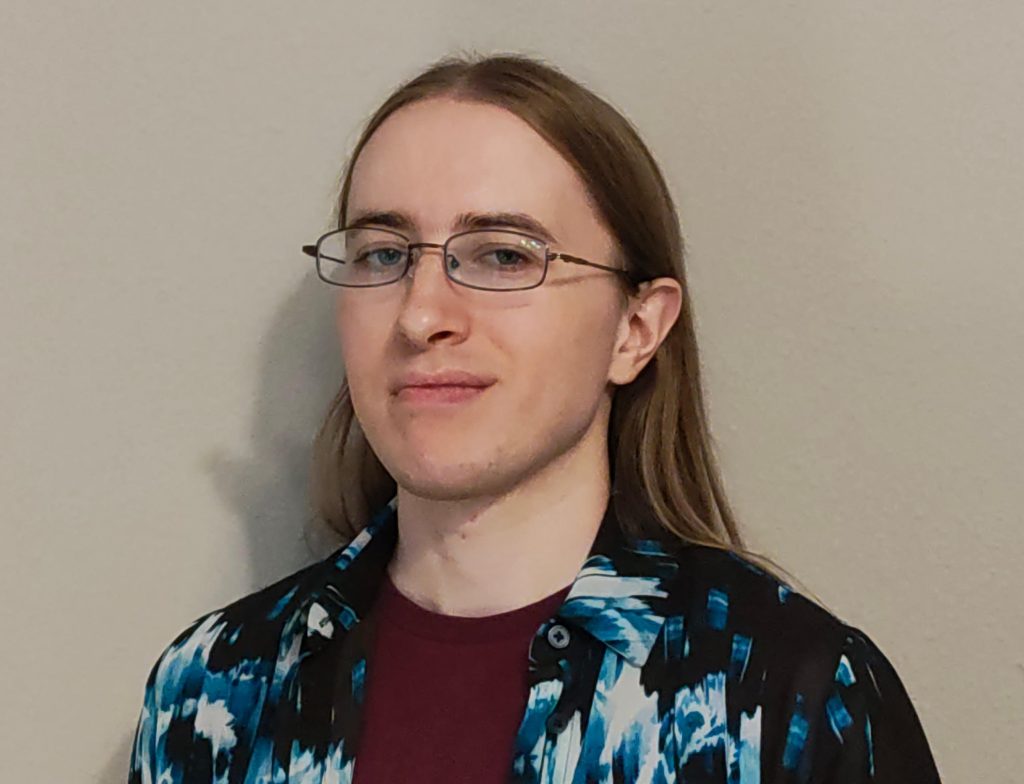
Riley Neither is a trans and non-binary writer of speculative fiction. Zer short fiction has appeared in Beneath Ceaseless Skies, Cast of Wonders, and elsewhere. With a PhD in linguistics, ze currently works as a researcher and copy editor for an educational nonprofit and spends zer free time writing, making art, and singing in a queer chorus. You can find zim online at www.rileyneither.com.
If you enjoyed the story you might also want to visit our Support Page, or read the other story offerings.