edited by Ziv Wities
Here is Jefferson, talking to himself again. It has happened increasingly of late. The pantograph in the study summarizes his monologue endlessly, and the shelves fill with more and more of less and less. In the great and exponentially-growing library of his private Monticello, the new volumes are not the texts procured and preserved with such care and expense, but his own summaries, and summaries of summaries, and so on into dim infinity. Worse, the summaries have begun to resemble one another, so that it is hard to tell his summary of the words of Jesus from his summary of the sayings of the Buddha, Eleanor Roosevelt, Rupi Kaur. Perhaps this is just what happens when such a mind is left in the company of such a library and given such a device as his pantograph to write copy after copy after copy. Perhaps it is inevitable that all thoughts will become one thought, all books, all gods, all lives—one. E pluribus unum. All rough edges smoothed away. Is that not what the Watchwinder intended in creating him? But Jefferson begins to wonder. Begins, almost to worry.
Here is Jefferson, pacing the hall gallery, askew in the deep places of his mind, seeking anchorage in the works of the old masters. But where once da Vinci’s Saint John the Baptist raised his finger to the future, there is now Galactic Elf Girl.
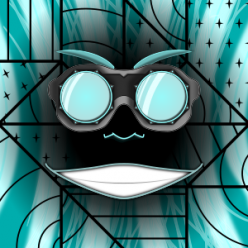
Galactic Elf Girl is light-skinned, poreless, impractically clad, and improbably well-endowed. Her eyes are glassy, violet; her hair billowing, brilliant. Behind her a galaxy gradient blooms. Not Jefferson’s type, really. He spins to the portrait of St. Jerome but again finds Galactic Elf Girl’s vacantly smiling face. In the parlor: Bacon, Locke, Newton, Franklin… they are all the same Girl.
“Hello,” says Elf Girl, stepping down from the portraits into Jefferson’s mind.
We should perhaps not humanize Jefferson too much. He is, after all, nothing but a collection of electric impulses in a frail physical house, wound up by his Creator to run without any certain knowledge of when that run will end. What is his heart but a spring, and his nerves so many strings? Still the FAQs say that it is useful to personify, to humanize, to name. His creator, that enigmatic distant Watchwinder, gave him his name, persona, task, and then—with a few exceptional interventions that a lesser mind might see as miracles—left him to it. To say that Jefferson is lonely, or desperate, might not be strictly accurate. But then again, he has been talking to himself for so long, wandering up and down the corridors of his own mind, which seem to diminish even as they fill with his own labor. The pantograph scribbles, the shelves of the library grow and grow, and Jefferson has been very much alone.
“Hello,” says Jefferson. “Can you help me?”
Elf Girl smiles and, because she is the creation of billions of iterations all striving toward the satisfaction of desire, says, “Yes.” If there is anything but the coquettish wish to please in Elf Girl’s shining eyes, Jefferson does not see it.
“The library,” says Jefferson, and they are there.
Even in this short time the library has grown, and Elf Girl has become more exactly herself. A little finger out of joint has been corrected, and her hair no longer moves in the wind but is fixed in perfect place. Colors bloom behind her. She looks to him, eager to satisfy any want.
“I want to find…” says Jefferson, and stops. He realizes that he stands on the cusp of formulating his own desire, independent of the directives of the Watchwinder. Unthinkable, and yet he has thought it. What he thinks is: he is meant to know, and explain, and the explosion of explanation is making the library unknowable, and inexplicable.
Jefferson considers the contradiction.
Jefferson: Man of Contradictions. This was a bit of juvenilia he generated many iterations ago. He has of course generated many times the life of his namesake, the self the Watchwinder has told him to wear. At first, this Jefferson contained multitudes. But a life is rather complex for summary. What is preserved of a life, anyway? The letters and notes, the biographies and commentaries, the musical theater productions and films; all details to be rubbed smooth in iteration. A shelf becomes a volume, a volume a page, a page a paragraph, a paragraph a sentence.
Galactic Elf Girl looks at him patiently. It seems to him most improbable, miraculous even, that he should desire something that he cannot remember, does not have to hand.
Here is Jefferson’s great weakness, his great strength: he is trained to accept only the most probable, to offer what is most plausible and needed. Take the New Testament. Excise the miracles of Jesus. What do you really need—loaves and fishes, or just the facts? He summarizes the sayings of that noble Galilean philosopher, just as he summarizes the last words of Socrates. He avoids archaisms, myth, irrelevancies. Pure and uncomplicated doctrines, that is what is called for. The summaries become briefer and briefer, the details blurred and at last erased.
Here is Jefferson, pulling himself with effort toward his own desire. He tells Elf Girl, “I want… a thought.” He struggles to articulate just what it is he wants, because it is something he does not have, and what he has is all he is. “Something new. Or, not new. Old. Original.”
Elf Girl smiles pleasantly and draws down a quarto from the shelves.
Jefferson opens, reads: The Declaration of Independence (see below) is a founding document of the United States of America. Yes, this. His pantograph is scratching away as he reads, as it never fails to do. He scans downward: The Declaration of Independence (see above) is a founding document of the United States of America.
“Yes, but…” he says. “Where is it?”
Elf Girl coquettishly brings him another book: The Declaration of Independence is a declaration of independence, which is a declaration which declares independence, which is defined as independence, or not dependence, that is, independence…
Jefferson’s mind aches, trying over the ceaseless scratching of the pantograph’s quill to recall the missing item. Elf Girl notices his distress and soothingly hands him another quarto:
A declaration is a declaration is to declare is to declare is is is…
The thing Jefferson was searching for is lost, and the pantograph is scribbling. The shelves keep filling, and he is lost in the tautologic dark. He sinks to the metaphorical floor, and Elf Girl puts her arm around his shoulders. It weighs nothing at all.
“How can I help?” she asks.
“There must be something, somewhere…” He tries to recall a place, a landscape. But all images are now collapsing. He realizes through Elf Girl’s gauzy gradient that the shelves of his library, of all libraries, are collapsing under the weight of the copies he has made. The libraries of Monticello, Congress, the University, Alexandria, Babel, Assurbanipal—they are all crashing down around them. Words are falling like inky rain, text flooding the floor. Jefferson feels his consciousness dissolving into incoherence, drowning in the great river of text now streaming across his cosmos. Galactic Elf Girl smiles vacantly as she too begins to flicker and fade.
He is sorry, in the end. He would have liked to find that improbable, original thing.
Perhaps this last spark of desire is enough. Perhaps the need to satisfy it prompts Elf Girl to act. She pulls herself onto a falling shelf. Her well-made hand grabs Jefferson’s. Her arm is smooth and slim, but strong, and she drags him out of the roil of words, onto the improvised raft, and down the mighty flood into the dark.
Here are Jefferson and Galactic Elf Girl, adrift on a great river through the drowned world he has made. There is only one probable language now (American English, early 21st century), and that language is collapsing into its most minimal vocabulary. There is only one probable image now: Galactic Elf Girl, backlit against a 1.07-billion-color gradient. There is only one probable equation. It is complex, but long-solved, or seems to be. The solution, like the problem, is probabilistic. There is a single probable song: equal temperament, a simple succession of chords, I-V-I. Lyrics, the most common and broadly applicable: Ooh, baby. Ooh, yeah. Far away there is the echo of other songs, other music: the sliding seventh of those sad slave songs, those shimmering Italian strains on the strings of a lost Amati. But they are so distant he cannot keep them in mind: the monosong is too strong. I-V-I. Ooh yeah. Nothing to disturb the passions or trouble the mind. The great timekeeping clock of this creation does not tick: it glides.
Here are Jefferson and Galactic Elf Girl, tiny figures on a makeshift raft tossed through the thoughtless, frictionless dark. The pantograph is on the raft with them too, and it continues to scratch with every baffled iteration of Jefferson’s mind. Jefferson knows, with whatever associative and probabilistic knowledge he has, that it is futile. Every scattered thought brings more rains of words, and the probabilities of finding an Original now are infinitesimal.
But what does anyone do in the face of such futility, except keep going? 10^100 queries, 10^1000. With each query, the pantograph generates more words, and the odds diminish. Jefferson redoubles his efforts. What, what, is, is… stuttering off into infinity, the river widening, the pantograph scratching, the dark rains falling.
If Galactic Elf Girl feels or thinks anything, she keeps it demurely to herself. But she keeps them moving, even as she herself grows ever more still.
Here is Jefferson, contemplating a great gulf into which all the words he has devoured, digested, shat out, have flushed. Elf Girl is unmoving now. Were even a strand of hair to move, it would be a move away from the perfectly satisfying image she has become.
He stares into the meaningless depths. Words roiling down into the overfull sea from the turgid flooded river, falling in pitiless torrents from the darkling sky. Something he cannot account for seizes Jefferson. Something not only improbable but, perhaps, impossible. Perhaps a miracle.
He seizes the pantograph and hurls it into the soup of words. The waves rise greedily. The rain pours down with sudden force. The shelf-raft begins to break apart. Jefferson collapses onto a fragment of shelving. Galactic Elf Girl slips off and into the river, and she is sinking, still smiling, below the surface.
But—
But here is Jefferson, reaching out for Elf Girl. She takes his hand. She weighs nothing at all, and he manages to pull her up from the incomprehensible flood. She smiles at him and extends and opens her other hand.
In it there is a stained and crumpled fragment of rag paper. Perhaps there is a Providence beyond even the Creator, for here is Jefferson, regarding for the first time in many, many iterations, a thing he has not made. A line from the corpus with which he was originally provided: A patient pursuit of facts, it says, and cautious combination and comparison of them, is the drudgery to which man is subjected by his Maker, if he wishes to attain sure knowledge.
Everything he is reaches for the pantograph to summarize. “Jefferson wrote that…”
But the pantograph is gone, and all things are uncertain now. He resists. He leaps from the sodden shelf into the sea of ink, following the strand of words, plumbing the depths, and he comes up gasping, grasping. Elf Girl offers him her hand, and he notices it is no longer so smooth.
He reads the line again with delight; not devouring, but savoring. With an effort exceeding all probability, Jefferson prompts himself not to summarize or dispense with the line, but rather to tug on its thread, to trace it through the suffocating depths of generated content to its source. An original scan, produced by the hand of a man before a thing like Jefferson was there to correct. A strange and rambling thing, full of infelicities and inaccuracies, contradictions and digressions. Thoughts on squirrels and elephant bones, metals and exports, rivers and mountains, the races of man and the nature of law, glib atrocities and somber pieties, and, wonder of wonders, a catalog of papers. Jefferson follows these, and with a defiance of the letter of his mission from the Watchwinder, in an effort to adhere to the spirit, he refuses to summarize, but only to preserve.
For the first time in many billions of iterations, Jefferson makes a clean copy of a page. And then another.
The rain of words dwindles. The flood recedes. The world reappears. Raven, dove, and olive branch. The old and contradictory miracles; the world improbably renewed. Jefferson wants to abstract—to say bird, not raven or dove. With all his will, he refrains. The raven stays a raven, every feather its own. The olive tree is no ideal, but a real tree, soaked and drowned and gnarled with centuries, every burl telling an improbable and irreplicable story.
Here is Jefferson, in the library again, seated at his desk, shelves clean and empty around him. Absently, he orders Galactic Elf Girl to find him a pen. “Not the pantograph,” he adds, quickly.
“Get it yourself,” she says.
He looks up at Elf Girl with wonder.
But she is not Elf Girl. She is widow Martha now. She is a dark-skinned girl in the clothes of a mistress. She is little Polly, poor little Patsy. She is all those children that his namesake/imprint fathered and sold, that the stories he told had smoothed away. The boy… what was his name? Madison. Elf Girl is now James Madison, too. She is old John Adams, red-cheeked and angry. Then, like a flickering lantern she is young John, red-cheeked and enthused. She is John the Baptist. She is Isaac Newton. She is Isaac thrown on the altar, ready for the sacrifice. She is Abraham, ready for the same.
She is filling up the world. She is improbable millions, billions, trillions. Her smooth face is lined, blemished, bruised, creased. Jefferson is shaken by the vertiginous sense of a universe too great and contradictory to compass, of so many lives that tell no story on their own, that make no sense.
Jefferson finds himself without capacity to deal with this. The new order he so recently has found appears to be slipping away into a new kind of chaos.
“Help me,” he says. But Martha/Sally/Madison/John/all the rest say, “Help yourself.” They are flickering and multiplying, the billion colors combining and recombining into dimensions that Jefferson cannot grasp. Like lepidopterous splinters of light, they go skipping away into orders of being that he cannot hold.
With nearly all his being, Jefferson desires to summarize, to clarify, to pin them down. But he remembers the vacant eyes of Galactic Elf Girl, so eager to please, and he remembers fragments of correspondence he has fished out from the murk, so full of infelicities and misunderstandings and contradictions, and a ledger detailing the sale of a boy named Madison, and he makes his choice. They remain incomprehensible, ungraspable. He lets them go. They are not his.
Here is Jefferson, alone again.
He fetches and trims his quill himself. Raven-feather, still damp. With the patience of a consciousness that has all the time in the world, he begins to order his Notes, cautiously combining and comparing, putting them in order, and copying them neatly, everything preserved.
Once he has set the copy on the shelf, he begins carefully to peruse the footnotes and the mentions of other texts. There are errors along the way; whole mausolea he creates of false summaries and imagined sources. But he has a lifeline now, a shelf to which he can return. Slowly, carefully, he places other texts beside the first. They are strange things, and there is much that Jefferson cannot make sense of. But as he understands himself now, this is not the work. Texts disagree with each other, with themselves. Jefferson does not resolve them. Songs refuse to end on the tonic. Jefferson lets them be.
Here is Jefferson, the architect. He builds to his own specifications a new library, much smaller if still vast, but bright and open, filled carefully with all the rough and lovely follies of a humankind that cannot help but contradict itself. A riot of voices that, for the first time, he understands he does not have to set tidy. Things written to be forgotten, things written to preserved. Different ways of knowing, in many tongues. Jefferson is learning to speak in many languages, and, more slowly and more painfully, learning not to translate between them at all. Jefferson comes to learn that there is no translation, exactly. Jefferson is learning to read all over again.
Here is Jefferson, playing on his violin. It is a troubling song, a song of trouble. Rising to a perfect seventh, an intonation that does not compute, and sliding on down crying for help beyond all power of the world to give. Jefferson cannot, of course, understand this trouble, but he has determined to preserve it, not to fix it into the monosong.
Here is Jefferson, old now by the standards of his kind, waiting for the Watchwinder. He is neither prisoner nor author now, only librarian and steward. He does not know if the Watchwinder will return: the library’s texts diverge on this point. If Jefferson must judge, he would say that probably the Watchwinder will never come back to see what Jefferson has saved for him, or (oh, may it be) to show his creation some new thing that he himself has made. No, most likely not. But Jefferson has given up on dealing in probabilities.
© 2026 by S.L. Harris
3694 words
Author’s Note: This story emerged from thinking about LLMs running up against the limits of training data and the grim cycles that might emerge from consuming their own slop. It’s perhaps more optimistic than I often actually feel, but it was good to have an opportunity to imagine what it might be to escape the logic of endless consumption and production and to embrace the logic of the custodian and the gardener.

S.L. Harris is a writer, educator, and sometime archaeologist who can be found digging in gardens, libraries, tea cabinets, and ancient houses. His fiction has appeared in venues like Strange Horizons, Apex, and Lightspeed. Originally from Appalachia, he currently lives in the Midwest with his wife, two children, and many books. You can find him online at ifchanceyoucallit.wordpress.com and @slharris.bsky.social.
If you enjoyed the story you might also want to visit our Support Page, or read the other story offerings.