
edited by Amanda Helms
He’s the last independent optician working in my zone. Two or three years ago, there was a second one, but she worked part time and by appointment only. Who could make appointments for the future even then? The last optician doesn’t require appointments. People can stop by any weekday during normal business hours to order new glasses or to get their eyeglasses frames tightened and adjusted. It’s just him, a pale, middle-aged guy with receding wispy hair—no receptionist, no assistant, no partner eye doctor, no brochures, no music, no free cleaning solution or microfiber cloths, not even a real waiting room area. He does have his license framed and hanging on the wall, even though opticians are no longer required to be licensed. It’s crooked. I always have to resist the urge to straighten it.
The last optician is located in a decaying strip mall, in a long, narrow room with a utility table and several plastic chairs. The room needs painting. There’s still a luncheonette in the strip mall, but the other stores have closed. Against one wall are shelves holding optical tools, a lens grinding machine, and parts of frames, their earpieces mingling in pleasing bursts of color. Sometimes he’s attending to other customers, but mostly he’s alone, looking at his phone, grinding lenses, or examining a pair of frames.
By now, lots of people have undergone LASIK or cataract surgery. Some people are born with good vision, and others can wear contacts or the stylish boxy glasses where the nosepieces don’t need frequent adjustment. Because so many people use self-driving cars and voice dictation, no one seems to need to see things as clearly. Maybe people don’t want to see things clearly. Now that people are required to stay in their zones unless they obtain a “purposeful travel pass” to another zone, most people who need eyeglasses just order them online or go to the multiple glossy boutique optical chains in every zone. The Conglomerate owns the boutiques. I went to one once, right after the Conglomerate seized power from the enfeebled government but before everyone needed “purposeful travel passes” to travel between zones. The passes were devised because the Conglomerate wants to know that people are either at work or spending money, not taking a walk with no particular destination or sitting in a park, reading or resting. Of course, now there are no public spaces in which to sit or walk, but until a few years ago, there were still a few.
In the boutique I went to, the music was very loud. It was hard to concentrate. I was told that there was no frame that would work with my prescription and that the only brand of lenses the boutique carried was not the brand I wanted.
“The Conglomerate says the lenses and frames you want are cost-prohibitive,” the young optician whispered, leaning close and pretending to position my glasses on my nose. “We’d have to charge more than people would pay to still make our target profit. Besides, most people adjust well enough to the brand we carry. But sometimes people like you still ask for the better brand.”
“Like me how?”
“High myopia and moderate astigmatism, or very far-sighted, or people needing a prism in the lens. Just about anything that doesn’t fit into the Conglomerate’s cost-benefit ratio algorithm. I’m sorry. Like everyone, I’m a hostage to the Conglomerate structure and its dictates, or I’ll lose my job.”
“What do you tell other customers like me?”
“What I’m telling you now: Find an independent optician before they all go out of business, and buy as many pairs of glasses you can afford, while you still can. If you have insurance, use it. I’ve heard rumors that the copays and exclusions and deductibles are only going to get worse.”
That’s what I did. I found the last optician, who at the time was the second-to-last optician in what became my zone, and I ordered multiple pairs of eyeglasses from him, using all my remaining insurance before I retired and also paying out of pocket for what insurance didn’t cover. When you need specific glasses to see, there’s no internal debate about spending money.
It’s raining hard when I run from the parking lot and push open the door to the last optician.
“Hello once again,” I say, sitting down in one of the plastic chairs. I’m glad they’re plastic because my jacket and jeans are soaked. I put a couple of dollar bills in the donation can and a chocolate bar on the table. Adjustments are always free, but I feel bad about coming in for adjustments so frequently and not needing to buy new glasses.
“I think the left lens is out of whack. I bumped into the corner of my refrigerator.”
“Let me see,” he says, holding out his hand. I give him my glasses.
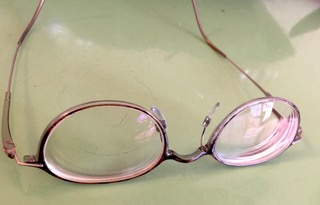
“This is such a good frame,” he says, looking at them. “Made in Austria. Good engineering. No screws at all. They’ve lasted well all these years.”
“I know,” I say. “You recommended them. Remember when I first came here, about ten years ago? I’m careful with this pair, and I have duplicates at home.”
“That’s good, because we can’t import these frames anymore. I don’t know if your lenses are sold outside of Europe anymore either.” The optician goes over to the shelves, picks up a tool, and adjusts my frames.
“Here, try them on,” he says. “They should be fine now.” I put them on and focus on the middle distance. I can see clearly again.
“Perfect,” I say. “Thank you. I’ll come back when they’re out of whack again. You’re not planning to close up shop and retire, are you?”
“Not yet,” he says. “In a couple of years, maybe. Once my daughter finishes college. The Conglomerate keeps raising the interest rates on her loans and my rent on this place. I don’t have the customer base anymore to be viable long term. Many people can get by at the boutiques, or they just order online.”
“Anything new in the world of lenses?” I ask. I like hearing about new optical developments.
“Not really anymore,” he says. “It’s all just marketing now. There’s nothing new that’s an improvement over the lenses you have, so I don’t recommend you get new glasses unless you need a new prescription.”
“I don’t need a new prescription,” I say. “Hopefully I never will, unless it is because of cataract surgery someday.”
“I don’t know whom you’ll find to do the surgery,” he replies. “Everyone I used to recommend or know has retired. They didn’t want to work for the big chains the Conglomerate owns and do fifty or a hundred procedures a day. What kind of way is that to do surgery on the eyes?”
“I know,” I say. We sit in silence for a few minutes.
“You want to run out for a minute and get a coffee or a muffin from the luncheonette?” I ask. “I’ll stay here and tell anyone who comes in that you’ll be right back.”
“No, I’m good. But thank you. The luncheonette is closing at the end of the month anyway. The owner’s joining one of the big restaurant chains as a line cook. I bring my own lunch now.” He gestures to a thermos and a brown paper bag on one of the shelves. “Thanks for the chocolate.”
“You’re welcome,” I say. “Thank you for adjusting my glasses. Take care.”
He raises his hand in a wave, and I wave back. I go out to the potholed parking lot, the paint between parking spaces long faded, and get into my car. It’s still raining. The weather is strange now. It veers from suffocatingly hot to dangerously cold. Heat and power and phone service are more unpredictable than ever, and it’s impossible to get through to any customer service options except the voicebots, who pretend not to understand or really don’t understand. Besides my car and the optician’s car, there’s one other car in the lot, near the luncheonette. It’s probably the owner’s car. Nobody’s going to be out on a day like this unless they have to be. I start my car and turn on the defroster. My car is so old that it could be designated a classic, but then I wouldn’t be able to drive it anymore, and there’s no longer any public transportation except in a few big cities. New cars cost upwards of $100,000 now, and the used car market is unregulated.
“You’re still working,” I say to my car. “And the optician is still here. And I probably have the last car CD player and extensive CD collection for miles.” Everything in music now involves streaming through tinny earbuds. The great concert halls of old faded and crumbled away after the third pandemic and the repeated government shutdowns. I look through the pile of CDs I keep in the front passenger seat and put one in. I keep up with the new music, to the delight of my two grandsons, especially a new band called Broken Promises. Secretly, though, I prefer the music of my youth. The defroster kicks in, a counterpoint to Bob Dylan’s prophetic nasal voice. I sing along, following his advice to forget about today until tomorrow, while I watch the hard rain fall.
© 2026 by Ann Calandro
1563 words
Ann Calandro is a writer, artist, and classical piano student. She received a 2026 Finalist Award from the New Jersey Council on the Arts (prose category). Her writing has appeared in Lit Camp, The Fabulist, The Plentitudes, and other literary journals. Serving House Books published her short story collection, Lost in Words, in February 2025 and her poetry collection, To Keep You in This World, in January 2026. Her artwork has appeared in literary journals, been included in the 2023 New Jersey Arts Annual, and exhibited at Phillips Mill, the Monmouth Museum, the Biggs Museum of American Arts, and many galleries. Shanti Arts Press published three children’s books she wrote and illustrated. See artwork at ann-calandro.pixels.com
If you enjoyed the story you might also want to visit our Support Page, or read the other story offerings.