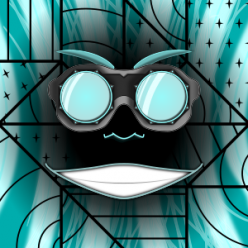
edited by David Steffen
It’s hard to reconcile Irina Treloar in her youth with the stunt-star who jumped through the moon. Archived family memories collage a girl with hunched shoulders and nail-bitten forearms against the unchanging backdrop of her room. From her room, she checked the shuttle livecast when her mother travelled for work. She agonised over friendships she couldn’t maintain. She watched the occupied system expand without stepping foot outside. This Irina, revealed through exclusive interviews and unprecedented access to private records, was far from the audacious woman known to the worlds.
The Treloars share these memories reluctantly, responding to widespread criticism of the late Irina. Before her death in the moon tunnel, she cultivated an image of indomitability, defining herself by her feats and keeping private any past struggles. In recent weeks, after leaked records revealed an implanted neural fear inhibitor, that image has tarnished with charges of recklessness and fame-seeking. Janie Mars, previous title-holder for the longest solo spacewalk, labelled her rival a coward.
Now, the family is speaking out. Irina Treloar, interplanetary daredevil, had an anxiety disorder. This, they argue, was more central to her stunts than any implanted circuitry.
Her symptoms manifested early. Former teachers describe her as a subdued but imaginative child, with the ability to invent a demise for every possible scenario and a compulsive need to plan for each eventuality.
“She was obsessed with death,” says her mother. “When she was little, she wouldn’t stay on a shuttle after the safety announcement. That was before she stopped leaving the home.”
By fifteen, even tools meant to help her anxiety had become restrictions. “It was like superstition,” her father tells me. “She was advised to exercise, so every morning she did fifty push-ups. No exceptions. A skipped ritual meant a bad day. She called it her anxiety noose, always drawing tighter. She hated herself for tying the knot.”
When FthanoPera Pharmaceuticals advertised for a neural implant trial, the family encouraged her to apply. This is how Irina came by her fear inhibitor: legally, before Dion’s Law was passed, and before she ever considered attempting a dangerous stunt.
Neural fear inhibitors rose to notoriety during the trial of coach and asteroid skier Francis Pelor, who cited inhibitor influence to plead diminished capacity for the manslaughter of pupil Dion Jones. After the judgement, in which Pelor’s training was deemed criminally unsafe, the family of Dion successfully campaigned to stop their production. The implant functions primarily by suppressing specific signals from the amygdala, preventing the secretion of stress hormones. From its inception, neuroscientists have voiced concerns about the impact on personality and decision making; concerns that Irina and those closest to her shared.
Her relatives, and the authors of the implant study, emphasize Irina’s caution and meticulous action-analysis. In the early weeks after becoming a recipient, she would plan every element of her day before its activation, and according to the results of the study, she never deviated from her predetermined intentions. Relatives also claim she was conservative in her use from the beginning. The implant’s archived data backs this up. Still, it’s an uncomfortable parallel: both Pelor and Irina pushed human possibility until they found the fatal edge.
Her sister refutes the comparison. “Pelor relied on his implant to participate in his sport. Irina used her stunts to prove that she wasn’t reliant on the implant. She wanted to feel agency over fear, and using the inhibitor would’ve defeated the purpose.”
This gets us to the heart of Irina’s motivation. She wanted to be free. Her first forays beyond the confines of anxiety happened under the inhibitor’s influence, but after each success, Irina would repeat it with her device shut off. She attended school in person. She met with friends. She took a shuttle to a Mars waypoint station. Soon, her successes didn’t involve the device at all.
“She always knew her fear was irrational,” says her sister. “That made it worse—more ingrained, more humiliating. To beat it, she needed to prove she was capable. Proof of experience, the security of an escape switch. Then, she needed proof that fear couldn’t confine her again.”
A pattern emerges: if it frightened her, Irina defeated it. For seven years, she had been unable to leave home. Thirteen months later, she became the youngest person to summit Olympus Mons on Mars. I’m shown her certificate, and the implant logs that demonstrate she achieved the feat with her inhibitor deactivated.
Around this time, she received her first offer of sponsorship. Soon, she was appearing in entertainment feeds across the solar system, surfing the gas clouds of Neptune and spelunking extra-terrestrial caves in a brand-plastered spacesuit.
“Money didn’t motivate her,” insists her sister. “It was about proving anxiety wouldn’t define her. Being in control.”
Was she in control? It sounds to me like this relentless pursuit of fears to conquer had become another ritual. I put it to her family. “Maybe she wasn’t,” her father concedes. “But she called it freedom. We weren’t going to point at her happiness and call it another cell.”
We move topic to the moon tunnel. Like many others, Irina’s interest sprang from the popular Our Haunted Solar System exhibition, in which the tunnel and its lurid history prominently feature. Friends took Irina to see the show, billed as a simulated ghost tour for the Space Age, for her thirtieth birthday. She returned obsessed.
“It [the moon tunnel] was a deep, dark hole laced with superstition. Of course she had to confront it,” says her mother with a watery smile.
Deaths have followed the tunnel since its beginning as a mining operation. Three engineers caught in a collapse while repairing an excavation bot. A survey team of ten. Fifty labourers in a decompressed mess chamber. When tourism giant Astronia proposed joining two shafts into one tunnel spanning the breadth of the moon, it was hailed as the most ambitious engineering project in generations. The refractory reinforcements at the core, once believed impossible, remain a scientific marvel. Millions flocked to the pod ride, but three fatal collisions and high maintenance costs saw the tunnel close to the public.
Irina proposed to traverse the tunnel in a record-breaking 3400-kilometer free fall. Her sponsors secured the permit.
The following events are well documented: Irina, broadcasting and wearing only her fortified spacesuit, jumped into the tunnel mouth, disappearing into the dark with the eerie lethargy of moon-motion. This footage is deceptive. With little drag to moderate her velocity, she quickly accelerated to incredible speeds, only slowing when she transcended the core and the mass behind surpassed the mass in front. Gravity now worked against her. On the other side, slightly inset into the tunnel, waited a platform where she was expected to complete her deceleration.
Here, things started to unravel. The calculations regarding ordinarily negligible atmospheric resistance and wall friction contained an error. She undershot, tumbling back.
Upon realising she wouldn’t make it, her team prepared a craft to catch her back at the initial jump site. Perhaps this contingency wasn’t sufficiently rehearsed, because a storage box close to the edge became dislodged during the preparations. Irina and the box fell towards each other, picking up momentum. They collided approximately five kilometres from the core. Irina died upon impact.
I ask if, in the light of her premature passing, her family wishes she’d never had the inhibitor.
“No,” her mother says. “It was her choice. She used it when she needed it, and we’re grateful she had it for those times.” She points me to a lone spike concluding the implant’s data.
There are still many uncertainties surrounding Irina’s death, including charges of negligence against members of her team, but the Treloars take comfort in this: when she fell to her end in the heart of the moon, Irina was unafraid.
© 2025 by Anna Clark
1298 words
Author’s Note: My inspiration comes from wasting too much time watching sports-drink-sponsored videos of extreme athletes. Partly. It also comes from my personal experience of anxiety (not entirely like Irina’s), which was debilitating for a number of years; even though it’s no longer nearly so acute, I’ve spent a lot of time wondering about the line between reasonable caution and negative avoidance. Ultimately, though, Irina’s story was written from curiosity about risk-takers and the people who love them, even when they all understand where it might end.
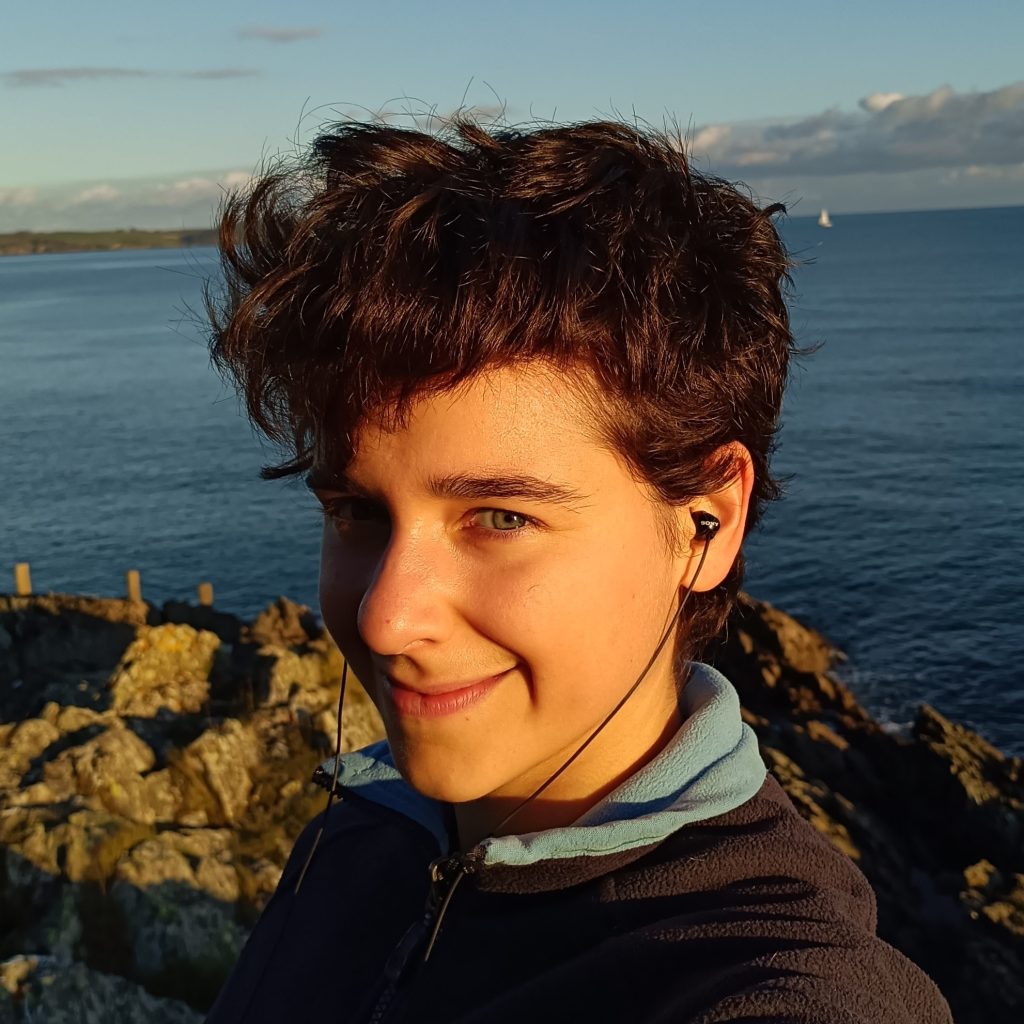
Anna Clark is a shipyard pipefitter in Cornwall, UK. When not fixing boats or swimming in the sea, she can be found writing fiction (often of the speculative variety) on the rocks by the beach. Her fiction has been published in Factor Four Magazine, Gwyllion, and Baubles from Bones. She sometimes hangs out on Bluesky under the handle @annaclark.bsky.social.
If you enjoyed the story you might also want to visit our Support Page, or read the other story offerings.
Nicely done.