Review: Throne of the Crescent Moon

written by David Steffen

This is the last of my reviews of works nominated for a 2013 Hugo Award. When the voting deadline came around, I was about halfway through reading this book, so I finished it up and wrote the review when I found the time. Throne of the Crescent Moon is the first novel by Saladin Ahmed, published by DAW books. You may recognize his name from his previous poem and short story sales. He’s been nominated for the John W. Campbell award, and his name has been appearing more frequently over the past few years.

Throne of the Crescent Moon is an epic fantasy story focused mainly around the ghul hunter Adoulla Makhslood and his assistant Raseed bas Raseed. Adoulla is the last member of his profession left in the world, with his stainless white kaftan that represents his profession. He’s not what you might expect from the job title, though, a fat and grumpy old man who’d like nothing better than to retire, drink tea, and rekindle a lost love who was driven away by his work. But if he retired, there would be no ghul hunters to oppose those who would raise monstrous ghuls from the elements to gain power in the world. Raseed bas Raseed is a young and lightning-fast dervish, a holy warrior who is a deadly fighter, but who is often unprepared for the hars realities of the world and who often finds himself and others failing to meet his lofty standards. Adoulla has hunted many ghuls over his decades of work, and Raseed has gained some experience alongside Adoulla, but now they are facing a new threat more dire than any that either of them have ever faced before, more dire than they thought possible. It will take all of their best efforts and great assistance from their friends to see them successfully through this trial. The fate of the world as they know it depends upon them.

Apart from any other aspects of the book, Throne of the Crescent Moon is notable among so many other epic fantasies in that the central cultures in this story are based around Middle Eastern cultures, setting it apart from the Euro-centric fantasy worldbuilding that has been the standard for a long time. That’s great; anything that encourages more creativity and variety in speculative fiction is a wonderful thing, though in my opinion. I understand why some have expressed great excitement about the book because of its roots being different than what we’re used to. Personally, that’s not what I focus on. I want a good story, period. Happily, this was also a good story, with good writing, and good characters, and doesn’t rely on its different roots to be its only redeeming factor. It is not a crutch, only one aspect of a good book, and I’m happy to see that.

The main party of the book, totaling five people in all, is a varied and interesting group who each get their own POV sections within the story (though Adoulla and Raseed are clearly the focus). There are at least four different magic systems at work among the group, suggesting a very diverse magical world, which helps keep all the characters vital, and makes the world more interesting. The story takes place in a time of political unrest as the Falcon Prince urges the citizens to overthrow the Kalif who rules the city. This political situation ties makes the city feel like a much more real place.

I really don’t have anything bad to say about the book. In the end, I ended up voting for John Scalzi’s Redshirts over this one, but only because that one felt entirely novel in a way that book plots rarely do, because of its strange metafiction format. Despite the Middle Eastern inspired setting in this book, I didn’t feel it made the story into a category of its own–we’re still talking warriors and magicians facing off against monsters–it’s a change in scenery and culture, but not really of format. Not that there’s anything wrong with that, but that’s the primary reason why it didn’t garner my primary vote this year.

I would recommend the book to anyone who likes epic fantasy. Well done, Mr. Ahmed.

Interview: Ken Liu

interview by Carl Slaughter
introduction by David Steffen

ken_liu_small

If you’ve kept up with science fiction publications in the last few years, you’ve probably at least heard the name Ken Liu. Dozens of his stories have been published just in the last couple of years in the biggest and best SF publications out there today, including F&SF, Analog, Asimov’s, Strange Horizons, Lightspeed, Orson Scott Card’s Intergalactic Medicine Show, Daily Science Fiction… The list goes on and on. He won the Hugo for “Mono No Aware” this year. He won the Hugo and the Nebula for “The Paper Menagerie” last year, one of my personal favorite stories I’ve read in years. I just read a fun story by him on the Drabblecast titled “The Call of the Pancake Factory”, about a representative of a certain supercorporation amusement park happening to cross paths with a cult of Cthulhu–great story. He’s on a roll, and showing no signs of stopping. He’s a great writer and you should check out his work if you ever get a chance to read it.


You’ve been getting an awful lot of stories published the last few years. Did you build up an archive or have you just been a really busy guy lately?

For the longest time, I wrote very slowly, and so there never really was much “inventory.” But I’ve been writing at a somewhat steady, faster pace for the last four years. The more I write, the more ideas I seem to have. So that has worked out well.


How do you maintain quality and quantity? Natural talent, hard work, long hours, disciplined lifestyle, or some combination?

I think over time, I’ve learned to do a better job of picking out which story ideas seem cool but won’t work, which ones are good for flash pieces, and which ones are good for longer development. That has helped to reduce the number of stories I have to trunk.

I’ve also learned to work better under deadline. Knowing how long it takes me to finish a story and polish it to the point where I’m satisfied with it builds confidence, and that makes it easier to take up new projects and plan them into my schedule.


What’s your day job? How do you find time for family, the office, and the keyboard?

I used to be a programmer, became a corporate attorney, and now I work as a litigation consultant for high-tech patent cases, which sort of combines my areas of expertise. It’s very interesting, stimulating work, and probably helps with giving me story ideas.

I have two young children at home, ages 3 and 1. As anyone with young children knows, they severely constrain your writing time. I’ve learned to be better about time management and use the little writing time I do have more efficiently. For example, I try to do some drafting on my commuter rail ride every day.

I can’t say I’ve got it figured out. My novel revisions are going much more slowly than I’d like, partly due to the lack of uninterrupted writing time. But plenty of writers have figured out such a balance before, I just need to keep on working on my process and improve it.


Some author’s sell to the same two or three markets or half a dozen markets. You’ve been selling to every market under the sun. What’s the explanation? Diverse material? Looks better on your resume? Just like to shop around?

I enjoy working with different editors. Every editor has taught me something new. And I do write a wide variety of stories, so some stories might be a better fit with F&SF while others might work better at Analog. Not every editor likes everything I write.

I also like being exposed to new readers through new markets, so being published in multiple markets has worked out well for me.


You’ve been winning and being nominated for a lot of awards. Mike Resnick said about awards, “When you walk out of the convention, nobody on the street knows who you are.” This in contrast to, for example, the Oscar. How has winning famous awards affected you personally? How has it affected your career? More sales? More fan mail? Invitations to speak at conventions? Requests for interviews?

I can’t say it has affected my personal life significantly — I did get a lot of congratulations from my friends and co-workers, which made me very happy. I think the stories that were nominated got more readers, and of course I’m happy about that.

Career wise, since I don’t have a novel, I can’t point to any concrete sales boost from the awards. I do think some of the translation deals I’ve gotten were due to the awards — if nothing else, they help with name recognition, especially overseas.

Unless people ask about the awards though, I just don’t think about them much. I’m very grateful to have been nominated and to have won some of them, but what keeps me writing isn’t the desire for awards, but to write stories that I want to read myself.


You’ve been concentrating on short stories. What does the novel horizon look like?

I’m working on a novel, an epic fantasy of sorts, set in a secondary world created by my wife and me together. The setting is an archipelago, and there are magical creatures, gods, and lots of fanciful machines based on ancient Chinese mechanical engineering. The plot is loosely adapted from the historical legends about the founding of the Han Dynasty, and some of the cultural aspects are derived from classical East Asian elements.

The first draft is done, but there’s a lot of rewriting left still.


What about the screen market? Any queries to or from Hollywood to buy or write scripts?

I do like scripts, and want to get better at writing them. But there’s not much of a market for them unless you’re in Hollywood, so, for now, I’m focusing just on narrative fiction.


What’s the market like for science fiction in China? Aren’t they more into traditional fantasy? You know, beings with magical powers. Personification of animals, like the famous Chinese novel, “Journey to the West.” (Or is it more accurately translated, “The Journey West”?) Is there a market in China for traditional science fiction? Biotechnology, space travel, etc.

I’m not an expert on the Chinese science fiction market, but from what I’ve seen, science fiction does very well there. Of course, China is a very big country, so even if only a small percentage of readers are interested in science fiction, the absolute numbers are going to be big. Liu Cixin’s Three-Body trilogy, for example, sold some 400,000 copies, and that’s a hard science fiction first contact story. (I’ve been engaged to translate the first book of the trilogy, The Three-Body Problem, into English, and Tor Books will be publishing the book in the US in 2014.)

A lot of my writer friends in China — in science fiction, fantasy, and slip-stream — seem to have many more readers (even if they don’t all have novels out yet). And even my own stories, translated into Chinese, seem to have generated more feedback than they received in English. So I’d say the market is very healthy, overall.


Besides China, how are overseas sales going?

I have a Japanese collection coming out from Hayakawa Publishing in 2015, and I’ve sold a few reprints to markets in France, Spain, Italy, and other countries. Sometimes I get a chance to work directly with the translators, and that’s always such a pleasure.


You have all your stories critiqued on the Critters Online Workshop. How has that affected your writing and your sales?

I haven’t used Critters for most of my fiction for a while now. Over time, I’ve developed a circle of beta readers (several of whom I met through critters) whose opinions I trust, and it’s just more efficient to get their take than to go through critters, especially when I’m under tight deadlines.

I think Critters taught me, above all, how to figure out which critiques are helpful and which ones are not. When you’re relatively inexperienced as a writer, there’s a lot of benefit to getting a wide range of opinions because they help you figure out who your target audience is. Learning to ignore opinions from people who aren’t in your target audience is a difficult lesson because our natural tendency as writers is to try to please everyone. But that’s impossible, and it’s better that you learn this lesson earlier rather than later.


Any advice for aspiring writers?

Listen when other writers share their process and try their techniques out, but don’t be surprised when most of them don’t work for you — but also be prepared for the possibility that a few will. You won’t know which is which until you try them though.


Carl_eagle

Carl Slaughter is a man of the world. For the last decade, he has traveled the globe as an ESL teacher in 17 countries on 3 continents, collecting souvenir paintings from China, Korea, Thailand, Vietnam, and Egypt, as well as dresses from Egypt, and masks from Kenya, along the way. He spends a ridiculous amount of time and an alarming amount of money in bookstores. He has a large ESL book review website, an exhaustive FAQ about teaching English in China, and a collection of 75 English language newspapers from 15 countries.


His training is in journalism, and he has an essay on culture printed in the Korea Times and Beijing Review. He has two science fiction novels in the works and is deep into research for an environmental short story project.


Carl currently teaches in China where electricity is an inconsistent commodity.


Daily Science Fiction: June 2013 Review

written by Frank Dutkiewicz

Did you contribute to Daily Science Fiction‘s Kickstarter campaign? If so, thank you very much. They made their goal with room to spare. That means the daily emails with delightful and never-read-before work of science fiction and fantasy will continue. Did you catch all that June had to offer? If not, this is what you missed†¦


“Pictures in Crayon” by Elizabeth Shack (debut 6/3 and reviewed by Dustin Adams) takes place in a far-future, dystopian world where the earth is dying, and children are taken off-world via a lottery drawing. The narrator wants to see other stars, wants to get off earth, wants to live, but she’s not the only child in her family.

I thought the ending was somewhat predictable, however, it was no less enjoyable, and melancholy.


“Note to Self” by Hans Hergot (debut 6/4 and reviewed by Dustin Adams) starts in such a humorous way that I was expecting a continuous laugh riot. However, the story turned sentimental and became the best of both worlds.

Thomas’s future self has won a time-travel contest in which he’s allowed to write six words to his past self to be delivered at a particular time. (Which isn’t fully explained, but doesn’t really matter.) I won’t spoil what the six words are, because what they mean is greater than what they say, which is what makes this story so great.


“Three Wishes” by Melissa Mead (debut 6/5 and reviewed by Dustin Adams)

In another delightful, twisted fairy tale from Melissa Mead, a golden coyote is stuck in a trap and thus rescued by a simple woodcutter. The woodcutter is given three wishes and mistakenly, and humorously, wastes the first two. His wife lets him have it for his foolishness, but demands the third wish be saved for something wholly selfish. She is a good wife. However, (spoiler) the woodcutter’s second wish absolutely needs to be undone.

This story, aptly, comes with a twist you might expect from a three-wish story. The twist, however, has a lot of heart.


“True Love” by Alex Shvartsman (debut 6/6 and reviewed by Dustin Adams)

At Temporal Excursions, Inc., you can step inside the mind of a past figure and experience their lives precisely as they did, minute by minute, in only an hour.

Molly seeks the experience of pure love. The kind, she says, that just isn’t seen around. However, she is repeatedly discouraged by the real lives of Helen of Troy and Cleopatra. Apparently our history books aren’t as accurate as the true day to day lives of these historic women.

But after each disappointment Travis, an employee of Temporal Excursions, is there to listen just as he is there to plug Molly back in during each subsequent visit until. Through with the past, Molly just might have discovered something of interest in her present.


“The Ships That Stir Upon The Shore” by Rahul Kanakia (debut 6/6 and reviewed by Dustin Adams).

In a future where the earth’s temperature is a deadly problem, people have been relegated into domes to survive. (However, this is not the focus of the story.) A broker of homes’ possessions sets his sights on a wealthy home whose owner is still alive. In the hopes that everything goes according to plan, based on past performance, he brings his family along to assist in the transition between the previous owner and them.

At first I was confused. The world made a lot of assumptions that I knew what the heck it was talking about. Then it settled into its story and I was sucked in – completely. What unfolds is as heartwarming as it can be in this quite dystopian future. I wished for a little more set-up regarding the change of heart. However, I still feel this is a top-notch story.


Simon gets an awesome gift that will spare him from pain in Jumping Into The Sky” by Samantha Murray (debut 6/10 and reviewed by Frank D). Grandma had finally sent Simon a birthday gift worth using: invulnerability cream, good for one day. He always wanted to jump off a cliff, remembering the look on Laura’s face when he backed out on a dare from before. The cream grants him the courage to dive ahead; an easy thing to do when the consequences are eliminated.

“Jumping” is a tale for those who wished they could summon courage from a jar. This predictable storyline has an unpredictable finale. The side effect was logical, but unforeseen. Well done.


A miracle drug promises to cure everything in Curing Day” by Dustin Adams (debut 6/11 and reviewed by Frank D). The protagonist is a nine year old boy centuries old. Pathway is a miracle inoculation that fixes all but erases memory. Shamus is one of the few who retains his memory. He alone sees the decay and remembers the ones who have died from accidents. The world is slowly falling apart and he alone can remember the slight changes of the effects disrepair.

“Curing Day” is a story I read in an infant draft. This final draft is a testament on how much work it takes to turn a good idea into a marketable story. Loved the concept of this piece , a world that decays while a society is locked in a pharmaceutical induced amnesia. Well done, my friend.


A bullied boy seeks sanctuary in his City of Chrysantemum” by Ken Liu (debut 6/12 and reviewed by Frank D). Bobby is a target of bullies. The small boy is tormented and beaten daily. On the pages of his art and in the corner of his mind he imagines a prince like himself in a city where boys aren’t forced to fight and are free to live in peace.

“Chrysantemum” is a fantasy only in the mind of the author’s protagonist. Bobby has a tale so many can identify with. His school is his dungeon. His two classmates are his predators, seeking him out so they can dish out their sadistic punishment for their own pleasure.

“Chrysantemum” is likely the least speculative story DSF has ever published. The tale is sad because there is too much realism in it. Bobby is not just a victim of cruel kids who say hurtful words that will inflict harm on his confidence. He is practice for future felons earning their own education in what should be the safe confines of a public institution. Bobby’s make believe kingdom serves as is his sanity’s refuge, his way of coping in his adolescent hell.

If you are sensitive to children being abused, avoid this tale. But in my opinion it is a story we should all read.


A superhero finds her rival, friend, and lover in Dark, Beautiful Force” by Jessica May Lin (debut 6/13 and reviewed by Frank D). The protagonist is a defender of justice who competes with another hero. The two develop a relationship as they battle the forces of evil and become intimate. The battle between good and evil will always carry on, regardless of the obstacles in life.

“Dark, Beautiful Force” is a tale of an extra special woman and her soul mate. The powers of the characters are unknown and the villains they fight are faceless. The struggle in this tale is of the inner turmoil the protagonist battles as she first competes than falls in love with her rival. The protagonist loses her unborn child while battling a vague antagonist. The loss leaves her hollow inside, and her depression drives a wedge between the two heroes. Her soulmate hatches a plan to save her from herself.

The vagueness of this superhero tale robs the story of its superhero flavor. The story almost could have been told without superhuman powers. The only fight that matters , to the protagonist and the reader , is the battle our heroine had with herself from the start. The plan her lover hatches (I would imagine) would do the heroine more harm than it could possibly do good. For all its vagueness, I found this tale nevertheless enjoyable, despite its dark conclusion.


“I’ll Leave The Light On” by Patricia Russo (debut 6/14 and reviewed by James Hanzelka)

Dahyana found the boy throwing rocks at a stop sign. She recognized him immediately by the glow. Mrs. Miller told her she would recognize them, and she had because they were like her. She took her time slowly developing rapport, drawing in the angry young man. He would always be angry until she could bring him to others like her. Bring him in, train him, teach him; only then can he fulfill his purpose.

I found the writing in this one a little uneven in spots, particularly the opening paragraph. If you work your way past that particular sandbar, you will find an intriguing story about people that live among us, but have a very different reality. I would encourage you to put in some extra effort and give this story a try.


“The Silver Witch” by Tara Calaby (debut 6/17 and reviewed by James Hanzelka)

When Rosalind was discovered straddling Leda the townspeople knew she was a witch. When the miller (whom she had rejected), the priest, and Leda’s betrothed testified they were sure. The decision was made. Rosalind must die to cleanse Leda’s soul of her spell. But when they tried to carry out the sentence the townspeople discovered something about the power of love.

This story is well written and gives us something to consider about how and who we fear in the world. It does so with a twist that that shows us even more. It also says something about the power of love. Give it a try.


A priest is sent to hell to find a man among the damned in Holy Diver” by Gra Linnaea (debut 6/18 and reviewed by Frank D). The protagonist is chosen by God to find a single soul in the fiery pits of hell. God had him sacrifice himself so he would gain entrance into the underworld. Hell is like a prison, priests are singled out , as if they are criminals who have committed a crime judged too heinous even for the fellow prisoners to accept. The protagonist learns to adapt in hell, as he searches for a man God so badly wants him to find.

“Holy Diver” is so much like a war story. The protagonist is on a mission in enemy territory. He knows nothing of the man he is searching for or the reasons why God wants him to find him. He is just a loyal soldier in God’s army and does not question his unknown orders.

I found “Holy Diver” to be an extraordinary and risky tale. The mystery of what the damned priest could be looking for , and the landscape of hell he walked through – had me hooked from the start. The answer to this mystery was a stunner. A warning to the faithful: the twist to this story you may consider blasphemous, so you may want to avoid it. I, however, loved the direction and the implications of the finale.

Recommended.


The Big Bad Wolf plans a big meal in Big Bad’s Hot Date” by Melissa Mead (debut 6/19 and reviewed by Frank D).The wolf of “three pigs” fame, plans a nice pork roast for his date. The trick is getting the slippery porkers to join in the meal. Thanks to his ingenuity, and the pigs’ predictable pattern, his date is destined to turn out just fine.

Inventive take on an old classic. I liked the way Ms Mead’s devious mind thinks. Well done.


Part of an immortal conscience faces irreversible death in Restorative” by Andy Dudak (debut 6/20 and reviewed by Frank D). The 3877th instance of Fingal Boyd is told he cannot rejoin the collective conscience because he has been inflicted with a virus. His shell, or ‘meat puppet’ , a man named Ciaran who has whored out his body, reflects with bitter irony that they will die together. Regret fills 3877 as death nears. He has never cared for his host body before, but weighing your actions of your life , and how they affected others , is a new experience for the greater being of Boyd.

“Restorative” is a tale set in a repressive society. Although the story is too short to fully explore the ramifications of a conscience impressing itself into one of the downtrodden, the plot to this piece centers on one part of a split being abandoned by its greater self. The vessel 3877 has occupied was once its own person. Ciaran had sold himself to be used, and abused. Now used up, 3877 feels the consequences of what he has done to Ciaran, and 3877 does not like it.

My main complaint to “Restorative” is it was far too short. A far larger , and better , story was left untouched. A thought provoking story with a satisfying ending.


A grieving actress is asked to reprise a memorable role in While Memory Holds a Seat” by Nina Kiriki Hoffman (debut 6/21 and reviewed by Frank D). Rose is a member of a planet-hopping traveling theater troop. Dark and tragic events in her past transformed the once bubbly girl into a withdrawn and depressed woman. A decision of what to preform must be made for the troop’s next stop. Verna, her daughter, suggest they do ‘Beauty and the Beast’, and wants Rose to play Belle.

“While Memory” is a story about a woman who has condemned herself to her own hell. A tragic accident has left her hollow inside. The tale is mostly a mini-biography of Rose’s past. It is all a set up for climactic finale that was dulled by the lengthy and depressing backstory.


A couple attempts to rid their world of a pest in All Kinds to Make a World” by Georgina Bruce (debut 6/24 and reviewed by Frank D). The protagonist and his wife find a creature outside their home and do their best to kill it, but try as they might the little bugger refuses to die. They don’t give up at first, but in a weird Stockholm syndrome twist they come to adore the monster.

“All Kinds” is a strange story (I mean that with modest sincerity). Like the creature in the tale, I became endeared with it by the end.


Two young students pine for each other in Pinned and Wriggling on the Wall” by Usman T Malik (debut 6/25 and reviewed by Frank D). The protagonist is spending one last evening with his girl, Sara , a med student with a talented hand for sketches that come to life. They are in love but her father makes it impossible for them to be together.

The subplot to “Pinned” is the two-dimensional beings that Sara has drawn in her notebook. One drawing attempts to escape while the protagonist makes a play for Sara’s heart. I confess, I did not connect the relevance and/or metaphor the author was seeking for this tale. I am afraid the story’s point was lost on me.


The innocence of youth can be quite tragic in Such Days Deserved” by Lee Hallison (debut 6/26 and reviewed by Frank D). Annie and her young friends have claimed the empty lot as their own. They have dug a hole and called it their fort. So when their fort is occupied by a strange – and scary looking – visitor from beyond, they react in a most human way.

“Such Days” is ET gone wrong. The opening paragraphs open with Annie and her innocent hopes as she stares up at the stars, which makes the gravity of what happens afterwards very shocking. I think the events of this tale would probably be the most likely outcome of a first contact scenario. I think the choice of using children made this worked best. Well done.

Recommended.


A soldier’s bid to fight repression crosses lines in The Frenchman’s Jihad” by JT Howard (debut 6/27 and reviewed by Frank D). Jean is part of an elite fighting unit combating the spread of contraband seed in the farming community. The son of a farmer cut down by thugs, Jean is happy he no longer works in the fields. His unit is out to stop the illegal seed trade, no matter what.

“Frenchman” is a tale set in a world of tyranny. It is a story where a soldier suddenly realizes he is on the wrong side. The author is an experienced warrior, and the tone and details shows the depth of his knowledge. “Frenchman” is a sci-fi war story very much like the speculative fiction tales told in the height of the Cold War. I found it to be crisp and compelling.


A sick woman exhausts the memories she stored for her daughter in Melancholia in Bloom” by Damien Walters Grintalis (debut 6/28 and reviewed by Frank D). Helen has a family heirloom for her daughter Rebecca: a magical box that stores memories. It is a treasure Helen found after her mother died, and in it, are the strips of cloth and the notebook her mother left for her explaining the magic of the box. For years, Helen has stocked the box with rose petals full of memories and a diary she has kept for Rebecca, but a debilitating disease has struck Helen and memories meant for Rebecca are the only things that keep her connected to this world.

“Melancholia” is a story told from two perspectives. From Rebecca’s point of view seeing her mother as a once lively woman now locked in a vacant shell, and from the words in Helen’s diary as she lives with the horror of losing her mind. Rebecca’s story is one that thousands of people could tell; the experiences of watching a loved one succumb to Alzheimer’s. Her mother is a woman who is lost to her; a walking catatonic, a parent who has left this Earth, yet still lives. The pain of viewing the vibrant woman she once knew now locked in a shell is too much for her to bear. Helen’s story adds an extra dimension to the tale. The magical box of memories is an heirloom passed down through untold generations. She found it after her mother passed away and discovered the gifts of memories inside. The rose petals she placed inside the box are memories she intended to leave her daughter, but the memory-fading disease that has her in its grip makes the temptation to re-experience what she lost to great for her to resist.

This story has a premise very much like Michael Haynes’s Scraps, but, where Mr Haynes’s piece was a tale of beautiful discovery, Ms Grintalis’s is a heart-wrenching tragedy. The two subplots of “Melancholia” complement each other. Helen is aware of the injustice she is doing to the boxes legacy and of the gift she is robing her own daughter, but the reader can’t blame her for it. Her written confession that choosing not to seeing a doctor when the first signs appear because it would ‘make it real’ is something we all can sympathize with. The recaptured memories allow Helen to be normal once again, even if it is for a brief moment. They keep the disease at bay, but the memories she has stored , and meant for Rebecca to experience , are finite in number and will be gone once spent.

I wondered when I finished this tale if Daily SF was Ms Grintalis’s first choice to publish her story. I’d imagine that a good many publications would have told her that it wasn’t right for them; a modern fantasy, short in length, a quick narrative and , most of all , an ending that was anything but happy. Not quite dark enough for a publisher of horror but the complete absence of cheer would have likely disqualified it for a bunch of publications and that is too bad. The early speculative fiction TV classic Twilight Zone proved that the very best tales don’t have to have a happy ending for them to be enjoyable. In fact, the bitterest endings in that show are where it achieved its greatest accolades, and like those memorable but bitter episodes this story deserves praise reserved for a true classic.

“Melancholia in Bloom” is a dynamite work of art. From its aptly named title to its somber finale this is a tale worthy of remembrance. Thank you Daily SF for delivering it to my email box.

Highly recommended.


And then there was one†¦

On June 27th Dr. Steven Wittenberg Gordon announced on his writer’s blog , Songs of Eretz – that he would no longer be reviewing Daily SF on a regular basis. For an entire year, Dr. Gordon wrote a review of every DSF story the day it debuted , no small feat. His reviews were honest and thoughtful, and he didn’t miss one in all that time , including the ones that were written by the Diabolical Plots staff. And to prove we can take it, as well as dish it out, here is what he thought of our work.

“Coin Op” by David Steffen
The business-like, complete lack of emotional response from the android was amusing, as were its sexual extortion tactics. A snide comment at the end of story detracted a bit; there was a missed opportunity to make this a moral tale with a chilling (ahem) climax. 3 out of 7 rocket-dragons.

“This Is Your Problem, Right Here” by David Steffen
This story was revolting and hilarious at the same time. Original and memorable. 7 out of 7 rocket-dragons

“Curing Day” by Dustin Adams
There is certainly the grain of a great story here. I wish Mr. Adams would have provided some explanation for how the anti-aging drug works and why the side-effect occurs. The story is a little difficult to follow, but its original premise makes it worth reading. 4 out of 7 rocket-dragons.

“Fool’s Gold” by Frank Dutkiewicz
A good story, but the intellectual dialogue from the mouths of supposedly uneducated serfs was distracting. 5 rocket-dragons.

Dr. Gordon provided what I’ve been claiming Daily SF deserves from the leading reviewers of speculative fiction , insightful, thoughtful, and honest assessments of the works offered by one of the leading publishers of short, genre specific fiction in the industry. It is a disgrace that the recognized reviewers have been neglected by them and a shame Songs of Eretz will no longer picking up their slack. We will miss reading the doctor’s opinions.

But hey, if the good doc would like to keep a toe hold in DSF reviews, we would be happy to make room for him. I’ll keep your work load light, Steve.
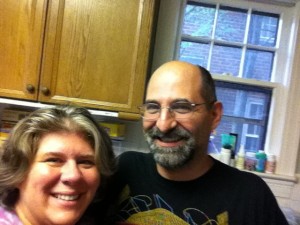
 

MB_JLWhy are these two people so happy? Because you came through for them. The editors asked for your help in funding Daily SF and you didn’t disappoint. They met their goals with room to spare. On behalf of Jon and Michele, thank you for your support.

“Reckoning” at Stupefying Stories

written by David Steffen

My flash fiction story “Reckoning” is now posted on Stupefying Stories for you to read for free. It’s the tale of southern fire-and-brimstone Preacher Paul and his encounter with Death. This one’s been around for a little while, though I think a recent complete rewrite of the ending is what helped push it over into purchase territory.

The story began from the opening joke:

“The Day of Reckoning is upon us,” Preacher Paul said.
“You reckon?” Jake answered.
“I reckon.”


I hope you enjoy! Feel free to leave a comment here.

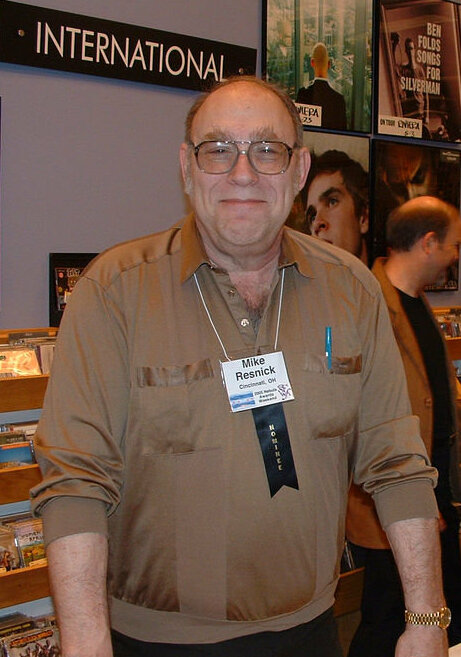
Interview: Mike Resnick

interview by Carl Slaughter

Mike Resnick recently launched 2 new projects. Stellar Guild, an anthology series, and Galaxy’s Edge, an ezine. Diabolical Plots asks
who, what, when, why, and how.

CARL SLAUGHTER: You did these type of projects in the 90s and launched a lot of careers. Why again? Why now?

MIKE RESNICK: This field has been phenomenally good to me over the years. I can’t pay back — everyone who helped me is either dead or rich or both — so I pay forward.

CARL: Will these 2 project continue indefinitely, with you turning over the editorship to someone else, or will you shut them down after you’ve accomplished certain goals?

MIKE: That’s up to the guy who pays the bills, but I don’t believe he plans on halting either project in the foreseeable future.

CARL: The magazine stories are free. What’s the business model for a free, online magazine?

MIKE: That’s a publisher question. I’m just the editor. I assume that being free online serves multiple purposes: it lets me recruit new
writers he may want to work with in the future, it advertises many of his books and projects (like the Caribbean cruise workshop) in its
pages, etc. And I should add that although it’s free online, we’re actually selling a surprising number of copies of the Kindle, Nook and
paper formats. And as each new issue comes online for free, the prior one is accessible only for a fee.

CARL: Speculative fiction is a big umbrella. Which subgenres will you emphasize and which will you exclude?

MIKE: I like science fiction. I like fantasy. I like humor. I like odd and offbeat. I have no interest in horror.

CARL: What percentage of stories will be original and what percentage will be reprints? What percentage of stories will have recognizable bylines and what percentage will be new names?

MIKE: We’ll be running 5 new stories and 4 reprint stories and/or novelettes each issue, so it’s 55% new, 44% reprint, and 1% left over.
The new stories will be by newcomers, or journeymen whose names aren’t well-known yet. The reprints will be by major writers whose names on the cover will theoretically keep us in business. We’re also running a science column by Greg Benford, a book review column by Paul Cook, and an anything-he-feels-like-writing-about column by Barry Malzberg. And my editorials seem to go a few thousand words each. Oh, and we serialize a novel each issue, we run a novel excerpt from the publisher’s list each issue, and we run a short story from one of the
publisher’s available collections each issue. Like the old Lucky Strike commercials, we’re firm and fully-packed.

CARL: How does the protà ©gà © thing work? Does the protà ©gà © write a story and the veteran help with revision or do they both write a story on a similar theme?

MIKE: I contact a superstar and assign him/her a novella. Then a protà ©gà © (of their choosing, not mine) will write a novella or long
novelette that is a sequel, a prequel, or just set in the same universe — and share cover credit. And when you’re a newcomer sharing cover credit with Mercedes Lackey or Larry Niven or Kevin J. Anderson or Robert Silverberg or Harry Turtledove or Nancy Kress or Eric Flint, it’s got to give your embryonic career a lot more of a boost than selling half a dozen stories to the usual markets.

CARL: All the established authors you contacted initially declined to participate. When you informed them the project would involve working with a protà ©gà ©, they all immediately reversed their decision. Why is working with a protà ©gà © such a motivation?

MIKE: For the same reason I work with beginners: to pay forward. I just ran through the names of the senior partners on these books. Most
are contracted years ahead, most make far more than we can pay…but the moment the philosophy of the line was explained to them, each of
these talented and truly generous writers instantly agreed. I should add that the very first Stellar Guild book to come out — Kevin
Anderson’s and Steve Saville’s TAU CETI — just won the very first “Lifeboat to the Stars” Award, which carries a 4-figure cash prize with it.

CARL: An important question for aspiring writers. Are submissions open?

MIKE: No, but I hope to open submissions soon. Maybe 3 or 4 months.

Carl_eagleCarl Slaughter is a man of the world. For the last decade, he has traveled the globe as an ESL teacher in 17 countries on 3 continents, collecting souvenir paintings from China, Korea, Thailand, Vietnam, and Egypt, as well as dresses from Egypt, and masks from Kenya, along the way. He spends a ridiculous amount of time and an alarming amount of money in bookstores. He has a large ESL book review website, an exhaustive FAQ about teaching English in China, and a collection of 75 English language newspapers from 15 countries.

His training is in journalism, and he has an essay on culture printed in the Korea Times and Beijing Review. He has two science fiction novels in the works and is deep into research for an environmental short story project.

Carl currently teaches in China where electricity is an inconsistent commodity.

Codex!

written by David Steffen

We’ve posted here from time to time to point out useful writing websites and tools, but it occurs to me that I have never posted about Codex, which I’ve found to be extremely enjoyable and useful in a variety of ways.

So what is Codex? It is a website founded by Luc Reid which serves as a resource and gathering place for neo-pro speculative fiction writers. The primary draw of the site is the forum.

A neo-pro writer, for the purposes of membership, is a writer who has had some measure of success: a professional sale, completion of an audition-only writing workshop, some amount of self-publishing sales, representation by a reputable agent, or nomination for an award. The purpose of the membership requirement is not to be elitist, but to try to gather writers who are at a similar stage in their writing careers. The membership requirement shows that the members have some experience, some skill, some measure of sucess. There are plenty of forums for beginning writers, and it seems like most of their threads end up covering the same questions that almost all beginners ask, so that any longstanding member will see many of the same questions over and over and over. So this helps avoid that.

And, although the site is focused on neo-pro writers, there are quite a few writers there who have made loads of sales and won awards who are active on the forum. You can see a list of some of the members here (I’m not sure it’s a complete list, but it’ll give you an idea). Ken Liu, Cat Rambo, Tom Crosshill, to name a few that were nominated for Nebula or Hugo awards this year.

There are many draws to using the forum, including:
1. A place to ask for advice on writing, legal matters, submission etiquette from people who have some history of writing success.
2. A place to just have fun with those some people, to get to know them. Codex contributed a great deal to my enjoyment of WorldCon in 2012. I’m not great at interacting with strangers, but Codexians aren’t strangers. I ran into Codexians everywhere I went, and so I’d always have somebody to say hi to, and then I could meet new people more easily then. One of the highlights of the weekend was the Codex breakfast, about 30 of us getting together at a restaurant on that Saturday.
3. There are threads where people share market response times and excerpts from rejection letters, which can be useful if you’re waiting for responses from the same markets or just to congraultation/commiserate.
4. It’s a great place to share news of story acceptance, and of publication, and to hear similar news from the other members.
5. There are writing challenges and contests to encourage you to write, and a critique forum to get feedback on your unpublished stories (I haven’t participated in these at this point, but I can see the appeal).
6. If you have a bad experience with an editor or a publisher, and you want to talk to others about it, but you’re not comfortable talking about it on a more public place, this is a reasonably good place to do it. I’d stick to the facts though, don’t go on a rant, because some members might be friends with the person, or if that editor is also a writer they might even be a member themselves. There’s also a thread where such things can be posted anonymously so that you can share news of bad behavior without worrying about backlash.

If you meet the membership criteria, I encourage you to join. It doesn’t cost anything to be a member, so you don’t lose anything by trying it out. Even if it didn’t have more tangible benefits to my writing, I find that it makes me feel like I’m part of the community. Really, the more the merrier! If you do join up, I’ll see you there!

If you don’t meet the membership criteria, I encourage you to make this one of your milestones to celebrate progress in your writing career (much like SFWA membership eligibilty is for a lot of writers). If you want to know more about Codex, they have a pretty thorough FAQ page.