DP Fiction #28B: “Regarding the Robot Raccoons Attached to the Hull of My Ship” by Rachael K. Jones and Khaalidah Muhammad-Ali

From: Alamieyeseigha, Anita

To: Alamieyeseigha, Ziza

Date: 2160-11-11


Dear Ziza,

You already know what this is about, don’t you, dear Sister? The robot raccoons I found clamped along my ship’s hull during this cycle’s standard maintenance sweep?

Oh, come on. Really? You know I invented that hull sculler tech, right? They’ve got my corporate logo etched into their beady red eyes so my name flashes on all the walls when their power is low. I admit some of your upgrades were… novel. Like the exoshell design–I’ll never understand your raccoon obsession. Impractical, but points for style. I hadn’t thought you could fit a diamond drill into a model smaller than a Pomeranian’s skull, so congrats on that. Not that they made much progress chewing through my double-thick hull, but I’ll give credit where credit’s due.

Still, it was unsisterly of you, and it’s not going to stop me from dropping the terraforming nuke when I get to Mars. Come to grips with reality, sister: you’re in the wrong. You always have been, ever since we were girls. Especially since Mumbai accepted my proposal for Martian settlement. Not yours.

I’m sending back the robot raccoons in an unmanned probe. Back, because yes, I’m still leagues and leagues ahead of you. I only lost a day cleaning up the hull scullers. I’ve kept the diamond drills. I bet they’ll chew right through that Martian rock.

I’ve also included a dozen white chocolate macadamia nut cookies, because I know it’s your birthday tomorrow. Happy birthday!

Now go home.

Love your sister,

Anita


*


From: Alamieyeseigha, Ziza

To: Alamieyeseigha, Anita

Date: 2160-11-12

Dear Anita,

Remember that summer when Father dropped us off at the northern rim of the Poona Crater on Mars? Alone. For two weeks. “This rustic camping trip will be a great learning experience,” he said. “My precious daughters will bond.”

When I learned that there were no pre-fab facilities and that we were responsible for erecting our own dwelling, sanitation pod, and lab, I started plotting ways to poison our father. You, on the other hand, I am still convinced, were determined to thoroughly enjoy the experience just to spite me.

But Father was a conservationist, and now that I am older, I can appreciate that he was trying to instill that same spirit in us. “Not all life jumps out and bites you in the butt,” he used to love to say. And we learned the truth of that when we unearthed a family of as-yet-undiscovered garbatrites in the red dust on one of our sand treks.

We spent hours watching them under high magnification under the STEHM, trying to communicate with them, recording their activities and creating hypotheses about the meanings of their habits. I have to admit, there was a point when I stopped cursing father and started to secretly thank him. And where I sort of, kind of, could maybe see why you weren’t so bad after all.

I don’t think I’d ever seen you so dedicated to anything before this. You missed meals and stayed up throughout the night trying to communicate with the elder garbatrite. The one you named Benny. Exhausted, you fell asleep at your desk and left the infrared light on too long and effectively fried the poor critter. You cried for days and you even held a formal funeral for Benny, something his fellow garbatrites didn’t seem too pleased about.

With that in mind, how could you possibly want to drop a terraforming nuke on a planet you and I both know is already teeming with life? Creating a new habitable world only has merits if it’s not already inhabited.

If you won’t see reason, then I’ll just have to make it impossible for you. The Council for Martian Settlement may have accepted your proposal, but let me remind you that I’ve never been keen on following the rules.

So, you found the hull scullers, eh? I knew those diamonds would distract you from my real plan. You’ve always been so… materialistic. But hey, someone has to be.

On another note, the cookies were to die for! They were even better than Mother’s, but I’ll never tell her that. I really appreciate you thinking of me. I have a proposal to make. On our next monthly meal exchange, I’ll make your favorite, a big old pot of Anasazi beans and sweet buttered cornbread, if you’ll send more of those cookies.

XOXO

Ziza

P.S. My sweet raccoonie-woonies, Bobo and Cow, liked the cookies too. They also send their love.


*


From: Alamieyeseigha, Anita

To: Alamieyeseigha, Ziza

Date: 2160-11-15

Sister:

Come now, Ziza. Let’s not make me out to be some kind of villain. Of course I remember that summer. I remember how we licked the condensation inside our lab windows to stay hydrated because Father’s Orion Scout childhood romanticized survival stories. It’s the real reason we’re such die hard coffee drinkers nowadays. He ruined the taste of water for us.

And I remember the garbatrites. How could I ever forget? That dusty red boulder we found in the sandstorm provided just enough shelter to pitch our emergency pod while we waited out the squall. Nothing to do but talk with each other, or play with the STEHM. Which meant we chose the STEHM, obviously. It’s the closest look I’ve ever gotten at you, all those disgusting many-legged organisms crawling on your skin and hair, in your saliva, your earwax. You’ve always had an affinity for vermin.

But I’ll be forever grateful you suggested taking samples around the boulder. When we first saw the garbatrites, their tiny little dwellings drilled into rock like mesa cities–that might be the closest I’ve ever felt to you, each of us taking one eyepiece on the STEHM, our damp cheeks pressed together, our smiles one long continuous arc. When the light brightened or dimmed, they danced in little conga lines. We weren’t sure if it was art, or language. Is there really a difference?

There’s something I realized when Benny died. The sort of revelation you only have when you’re nudging together an atomic coffin beneath an electron microscope with tiny diamond tweezers just three nanometers wide: life is short. Life is painfully short, full of suffering and tragedy and wide, empty spaces. And those rare spots hospitable to life are just boulders tossed into an endless red desert, created by accident or coincidence. The only real good we can do in life is to spread out those boulders, minimize the deserts where we find them. Make a garden from dust. Plant our atomic coffins and let them bloom. Terraform whole planets, so we’ll have more than just the blue boulder of Earth.

That’s what you never understood, dear sister. It’s why when you spent your youth chasing pretty men, I betrothed myself to science, burned my hopes of human love in the furnaces of my ambition. Do you remember when Asante, my poor besotted lab assistant, proposed to me at the Tanzanian Xenobiology Conference? How I laughed! As if any children he could give me would approach the impact my terraforming nuke will make on our species. Never forget, Ziza, that this mission is my life’s work, my legacy. You will not stop me.

In other news, I got the Anasazi beans and cornbread, still warm and fresh in their shipping pod. How did you know I had the craving? That was a kindness. I remembered you while making salaat today.

I was less pleased about the virus installed in the shipping pod’s warming program. Nice try, but I saw through that in about five seconds. Here’s a tip: next time, beta test it on all the shipboard systems I invented, not just the navigation. My sanitation program does more than filter my own crap.

I’m sending you an e-manual on Programming 101, and an ordering catalogue for Anita Enterprises in case you’d like to support the family business.

XOXOXO,

Anita

P.S. Go home.


*


From: Alamieyeseigha, Ziza

To: Alamieyeseigha, Anita

Date: 2160-11-28


Anita,

It’s been nearly two weeks since we last spoke, and of course, you know why. When you told me to go home, I knew that you were serious, but I never thought you’d resort to using the health and welfare of our dear mother as bait to get me to turn around and head back to earth.

I’m still trying to figure out how you managed to simulate for video not only our mother’s countenance, darkened and marred by some mysterious illness, but her voice, the cadence like smooth stones tumbling in water and her accent. When she pleaded for me to return home, telling me that she was afraid to die alone, of course I turned back.

How much time did it take for you to create those videos, one arriving each day, her looking progressively worse? The worst was that one video with her by the window in her study, Mount Kilimanjaro in the distance. It came on the third day. The sunlight that glinted through her silver hair, like icy filaments, made her look so painfully beautiful, yet it was not enough to erase the shadows beneath her eyes or the sadness in them.

A better question, I suppose, is “Why?” Why resort to that when you know how much Mother means to me, especially now that Father is gone? Are you still jealous of our closeness? Do you still believe she loved me most?

Not that you deserve to be, but I’ll let you in on a secret. I used to believe Mother loved me more than you as well. One day, I must’ve been about twelve, in my pathetic need to always be reminded that I was loved and cherished, I asked her why she loved me more than you. I waited a few moments, as she looked skyward, it seemed, for the answer. I was sure she’d say it was because I was more beautiful, more kind, smarter, that I had a more generous spirit, because truth be told, these things are true. But she didn’t say that. Mother told me that she did not love me most. Nor did she love you more than me.

Then why do you spend so much more time with me than Anita? Why do you kiss me goodnight and not her? I numbered all the things she did for me and not you. Do you know what she said?

Because you need me more than Anita.

In her way, which was always kind yet honest, Mother was telling me that you were the stronger of the two of us. But now, I wonder. Would a strong person use her sister’s weaknesses against her just to win? This was a low blow, Anita.

By now you’re probably wondering how I eventually figured out that the videos from Mother were merely a cruel ploy to get me to go back home without a fight. It was the video from Day Eight.

Mother lay in bed, slight as a sliver of grass. When her image popped up on the view screen my heart felt like it was trapped in a vice. She reached out. A tear traveled from the corner of her eye toward the pillow. She coughed, then called out my name. Her voice was so soft, so small and weak.

“Please hurry home, Ziza,” she said. “I don’t want to die without laying eyes on my favorite girl at least one more time.”

Favorite girl? No, Anita. Our mother never would have said that.

You think you’re so smart. You think you know everything. Yet, you don’t know kindness or humility. You don’t even know your own mother.

The decision to dedicate your entire life to science was an error. Life is so much more than entropy, polymerisation, and endothermic reactions. You really can have your coffee and the cream too. You should have married Asante. He would have humanized you. He would have taught you to slow down and enjoy the precious little moments, that together they all add up to a great big life full of disappointments, yes, but also joy and love and mystery. He would have saved you from yourself and cold loneliness.

This is where I remind you that you know nothing about programming that I didn’t teach you. Anita Enterprises is the mega-conglomerate it is because of me, your older sister and mentor. If I wanted to shut down every system on your ship, including life support, I could. And believe me, after this latest stunt of yours, I’ve been giving that idea serious consideration. The fact that I haven’t sent a couple of torpedoes your way is a testament to my love for our mother. She’d be angry if I killed you. So, I won’t.

See you on Mars.

Ziza

P.S. Don’t start none, won’t be none.

P.P.S. Bobo and Cow are very displeased with you.


*


From: Alamieyeseigha, Anita

To: Alamieyeseigha, Ziza

Date: 2161-01-01


Ziza,

It’s been weeks since I last wrote, but you haven’t been far from my thoughts. Far from it.

While I continue toward the planet, I’ve been passing the time on my escape pod making a list of all the reasons I hate you, numbered and ordered least to greatest. It’s a long long list, forever incomplete. A sister’s hate is like the heat death of the universe: infinitely expanding, eternal, the last flame burning in this cold, barren desolation where God abandoned us.

Reason #1,565: I hate the way you eat popcorn with chopsticks to keep your hands clean. Are you too good even for butter smudges?

Reason #480: I hate how you laugh at bad jokes. Puns aren’t actually funny, Ziza. Everyone outgrew “why did the chicken cross the road” after elementary school.

Reason #111: Blue eye shadow. Self-explanatory.

Reason #38: “Don’t start none, won’t be none.” Really? Better knock that shit off. Like you’re not an adult responsible for her own actions.

Reason #16: I hate how Mother named you after herself, like you were the pinnacle of all her hopes, while I was named to placate our pushy grandmother.

Reason #15: I hate how you always laugh at me.

Reason #10: I hate how your favorite animal is the raccoon. You only picked it because it’s endangered. You can’t resist a lost cause, even if you don’t actually want to do anything useful about it.

Reason #9: Seriously, blue eye shadow.

Reason #4: That last family dinner we had before Father died, when we took the shuttle out to the Moon to picnic on Mons Agnes while we watched the Perseid meteor shower dancing bright upon Earth’s atmosphere like the footsteps of angels. Mother brought her heirloom silver for the occasion; I think we all knew in our hearts it was a special trip. We’d agreed for Father’s sake to get along, just for a few hours. He hated how we fought, how we picked at each other like children picking old scabs that won’t heal. Do you remember the white curling through his black hair? His cheeks sunk deep by the chemo? He wanted to dish up the jasmine rice and flatbread himself. His hands trembled so badly the peas rolled onto Mother’s quilt beneath the picnic pop-up, just skirting the regolith.

We both know I wanted to talk with him about the inheritance. I just wanted my share, my 50/50 split, but Mother was so concerned about poor helpless Ziza, who had run into such tough times after college, chasing after pretty men and idealistic wide-eyed save-the-raccoons causes that she needed a larger cut to keep up her lifestyle. Anita Enterprises cost me everything while all you ever did was chase your girlhood dreams of love and happy endings.

We were having such a great time. Your useless pet raccoons were recharging their solar batteries in your lap. Father told us stories of his childhood, how they didn’t even have a family shuttle when he grew up, and you could only sleep rough in wild places like Antarctica’s rocky plains. Mother held his hand and kissed him, love shining in her eyes. No matter how sick he got, he was still the dark-skinned 17-year-old godling she’d met on the road to Mount Kilimanjaro in their youth. We even tolerated a few of your puns.

It would not last. I volunteered to scrape the leftovers into the recycler at the service booth down the path. It was so close, I didn’t bother to bring a communication device. You deny it, but we both know you followed me. You used the Moon’s lower gravity to pile those rocks against the door while I did my chores inside. When I tried to leave, the door wouldn’t budge. I could only watch my family from the viewing port, my mother and sister and dying father laughing together, though I couldn’t hear them. I screamed and pounded the window, but nobody noticed from the picnic pop-up. No one could hear me through the vacuum of space.

How can I ever forgive you that prank, those precious minutes of our father’s health ticking away, and me unable to be there? How can I forgive that lost opportunity, those memories that should have been mine to cherish, to bear me up when I wake at night so desperate to feel his whiskered kiss on my forehead, his voice telling me he’s so proud of me, proud of everything I’ve done?

This is why I hate you, Ziza. This is why I can never stop hating you.

Reason #2: Those diamond drills in your robot raccoons weren’t just drills. That cornbread pan wasn’t just a pan. You know what, Ziza? In spite of everything else, I only sent you back to Earth with those fake videos to protect you from yourself, and keep you out of harm’s way. Because despite this whole list, part of me still loved you, stupid as it sounds. Maybe it’s because you’re named for Mother. But you tried to dump me into the vacuum of space, Sister Dearest. You tried to murder me in my sleep. You activated the wafer computer in the pan’s false bottom, hacked my defenses, and the drills turned my hull into cheese by the time I woke up. If I hadn’t mounted the terraforming nuke to the escape pod… but I did.

Reason #1: Did you ever love me? Ever, Ziza? I’m not filling this one out yet, because I don’t think I’ve yet hated you as much as a woman can hate her sister. Not yet. But I will.

So I’m going to tell you something else you don’t yet know: On the wreck of my shuttle, scraping by on the last of my life support, are a dozen rare raccoon specimens. I was going to release them on Mars after the terraforming ended so they could colonize a safe place far from any predators. My shuttle is set to self-destruct in two days’ time. If you leave your current course, you might just have time to save them. Let’s find out what you care more about: helpless garbatrites, or near-extinct raccoons.

The shuttle also contains an urn with Father’s ashes, wrapped in extra scarves in the top hatch in my quarters. Mother asked me to scatter them on the planet because Father had so many happy memories of camping there with his daughters. I didn’t have time to rescue it when I had to abandon ship a few days ago.

I don’t have that one on my list yet. Better go add it now.

Hate you always,

Anita

P.S. Why did Ziza fly across the solar system twice? Because she was a double crosser. Get it?

P.P.S. Happy New Year, by the way.


*


From: Alamieyeseigha, Ziza

To: Alamieyeseigha, Anita

Date: 2161/01/02


Anita,

By now you’ve probably realized that regardless of your efforts, your escape pod’s trajectory is no longer Mars. You are now on an intercept path with me. I know that you must be seething, cursing my name, praying for my damnation (you’ve always been so dramatic), but give me the opportunity to explain.

Your ship was never in danger. The plan was that once you entered in new coordinates to anyplace other than Mars, preferably home, the diamond drills would have set about repairing the holes they’d created in the hull of your ship. Genius ancillary programming, if I do say so myself. All you had to do was turn around. But you, with your flare for the dramatic and unwillingness to give up, even when you know you’ve lost, decided to jump ship and make the rest of the voyage via the escape pod.

The escape pod. The escape pod with only half the power you’ll need to complete the trip to Mars. At the rate you’re going you’ll be one hundred and three before you even break orbit. If you paid as much attention to the details as you do the drama, you might have remembered that.

Why couldn’t all your hot hate keep those poor raccoons warm as your abandoned ship plunges onward toward the cold outer depths of space, too long and too far for either of us to go? I won’t be able to save those raccoons, nor Father’s ashes, because I will be saving you.

You can thank me later.

Your last message, so thick with evil enmity for your only sibling in the galaxy, reminded me of Tariq, the only man I ever considered staying with for a lifetime. I’ve tried over the last forty-three years, without an iota of success, to tangle and finally lose my memory of him among the many others. He was brighter than Sirius and sweeter than lugduname, at least to me. I know that long-legged bird wasn’t perfect, he chewed with his mouth open and, truth be told, he wasn’t very bright but he loved me without reserve.

You didn’t like him at first. You called him a “pretty, useless thing”, because he didn’t have the same knack for business or driving ambition for more, that you did. He was an artist and liked to create beautiful things, to experience the delights of life with all of his senses exposed and ready.

It was through your senses that he finally won you over. So thoughtful was he, that knowing your dislike for him, he still surprised you with your favorite, hot homemade waffles, on your birthday.

When I broke off the engagement with him only a week later, you, who had hated him all along, refused to speak to me for months. You said I’d made the biggest mistake of my life. You called me a fool.

I never told you why I broke off the engagement. And I bet you never knew that even now, there are sleep cycles when instead of sleep, I lay awake imaging how happy I’d be today had I not broken poor Tariq’s heart.

I broke off our engagement because of your Reason #1. In answer to your question, I love you more than breath itself, baby sister.

Tariq said to me one day, as we lay beneath the sun in a field of cool holo-grass, “Any sister who would waste her dying father’s final hours arguing over an inheritance is surely too selfish to bear.” He took my foot in his hands and kneaded my heel expertly. “I’m willing to tolerate Anita, my love, because of you.”

I said nothing to this for a while, mostly because the foot massage was so exquisite that it stole my breath and crossed my eyes. But when he was done, I politely slipped on my shoes, clapped off the holo-vision, and asked him to leave.

“If you love me, you must love my sister too. Anything less is unacceptable,” I told him.

So you see, silly sister, you can hate me a million times, but no matter what, I’ll still love you, even though you don’t deserve it. God, you’re such a brat.

Ziza

P.S. Are you seriously pouting about your name? Mother should have named you Shakespeare because you’re nothing but drama.

P.P.S. I didn’t pile those rocks against the door. That was Bobo and Cow. They were just trying to play hide and seek with you. I guess my sweet raccoonie-woonies won that round.

P.P.P.S. Why did the raccoon cross the solar system? To keep her sister’s paw off Mars.


*


From: Alamieyeseigha, Anita

To: Alamieyeseigha, Ziza

Date: 2161-01-11


Dear Ziza,

Greetings from Mars.

Don’t worry. Nothing has changed. I have regretfully failed to deploy the terraforming nuke. My mission has failed, for now.

Perhaps even before you read this message, GalactiPol will be taking you into custody. I called them when my escape pod veered off course, when the navigation stopped responding to my counter-hacks. You might have forgotten in your rashness that the Mumbai Council for Martian Development endorsed my plan for terraforming, and that I was their agent. Interfering with my mission meant meddling with the Coalition of Humankind itself.

I didn’t call GalactiPol sooner because I wanted to beat you at your own game. So few people in this huge, empty universe can even approach my creativity and intellect. You’ve always pushed me to the greatest apex of my brilliance. I’m never as inventive as when you’re scheming to ruin me. But the thought of losing Father’s ashes into the void of space… well, it gave me no rest. He doesn’t deserve that, not at our hands. I’d hoped you’d fetch the urn, but instead I’m calling an end to our battle of wits.

GalactiPol scooped up my escape pod and listened to my account of your wrongdoings. They have dispatched a salvage vessel to my wreck, and an armed cruiser to arrest you. Unfortunately, I made a fatal mistake: the raccoons. As you well know, I did not have authorization to remove these endangered creatures from Earth.

So they’ve arrested me too. I’ve been dropped on Mars for safekeeping while they run the raccoons back to Earth. They’ve dispatched another cruiser to your coordinates. Soon they will bring you here too, dear Ziza, and for the second time we’ll wander the sands together in this desert of red storms, with only wit and curiosity and mutual hatred to keep us alive until someone returns for us.

Did you know part of our old camp is still here? Somehow the shell of our mobile lab held up against the years. Probably because of the garbatrites. Remember we’d left the lab tucked in the shadow of their great stone. Apparently they liked it (perhaps for the way it holds warmth during the cold Martian nights) because they covered it in their tiny homes like a shipwreck bejeweled with coral and barnacles. When I turn on the lights at night, they dance along the seams in swirling shapes, carving microscopic paths through the dust coating, just as frail human biceps have pushed and moved the world until you can see their efforts from space. The Great Wall of China! The glittering glass megascrapers of Nigeria! How floating Melbourne glistens like a blue jewel in the dark, riding the waves forever, its flooded gondola channels sipping the ocean’s rise and fall! Our little lab is a world for these tiny creatures. They shout,  We are here. We exist.

But let’s talk about Tariq. Now there’s an unhealed wound running to our cores. It’s true, Ziza, that you were always the prettiest. I am a plain woman, an experience you can never understand. Your beauty is a passport into people’s best nature. Everyone sees in you the face of an angel, and they give you an angel’s due. Well, any plain woman knows the converse is true, that we have to prove again and again our worth and goodness to a world that mistakes the grotesque for evil, the ungroomed for lazy, the fat for stupid.

Your Tariq, like all pretty men, suffered from the same assumptions. He was never as good to anyone as he was to you, Ziza Angel-faced. When he didn’t ignore me outright, he liked to pick on me for your amusement. He named me Yam Nose and Ogre Teeth, and when I protested, he laughed me off as too sensitive, as if I didn’t have a right to my dignity. People like him are cruel to girls like me in a thoughtless, automatic way, like they can’t imagine us having feelings any more complex than a dog’s. Yes, I detested him. But the day he made me waffles, throwing me one small, quiet kindness, I realized how happy he made you, that you intended to marry him. He’d be around our family a long, long time. I made my peace.

I am sorry you realized so late the flaw in him that was obvious to me from the first. But know, Ziza, that Tariq must accept responsibility for his own character. If you had married him, when you aged and your beauty began to fade, he surely would’ve turned that same cruelty on you. He may very well have been your soulmate, but take a hard look at your own soul, and ask whether you too mistake your angelic face for more than it is. You are merely human.

So come to Mars, Sister. Come to where this all started that summer our father wanted us to bond, back before we hated the taste of water, before we learned to despise each other in small ways and big. We cannot escape one another. Our hatred has been our brilliance, our secret genius, the harsh red desert that pushed and pinched and goaded us to build towers you can see from the Moon. Imagine what a lifetime of love might have accomplished

Come to Mars, Ziza. Scatter our father’s ashes with me. If we cannot make this place bloom with life, at least we can make it a little more dusty.

Anita


*


From: Alamieyeseigha, Ziza

To: Alamieyeseigha, Anita

Date: 2161-01-11


Dearest Anita,

I can see the GalactiPol cruiser from my starboard viewport. Its black and gold stripes practically glow beneath the strobing orange beacon and make it look like a psychedelic bumblebee. Most people in my situation, facing detainment on Mars, endless expensive legal proceedings, possible time in prison, would be locked in the grips of fear and worry. Perhaps even shame. But not me. The one thought stuck in my mind, like a diptera fastened to sticky paper, is how beautiful that cruiser is and how excited I am to begin this second adventure.

It’s all about perception.

During that last picnic on the moon, when you were locked in the service booth, Father talked about perception. “Perception is everything. If you can project what you perceive it will become reality. You will believe it. More importantly, whether good or bad, everyone else will believe in your reality as well, and they will believe in you.” Not until I read your last letter did I realize how right Father was. And how wrong we have been.

In the mirror I’ve always seen the imperfect likeness of our mother, not quite as beautiful, not quite as kind, and with but a fraction of her intelligence. I have our father’s height and amber-flecked brown eyes, but none of his grace, strength, or athleticism. Yet, somehow you see in me the face of an angel.

In you I see the sharp mind and steady hands of a scientist. A fearless tenacious spirit intent on exploring all possibilities even at great cost, able to articulate your ideas, to change hearts and minds. You have boundless strength, so much so that you have been the central support for Mother and me since Father’s death. There is nothing plain about you, little sister, nothing wanting.

How is it that our perceptions have never aligned?

Be right back. GalactiPol is hailing me


*


From: Alamieyeseigha, Ziza

To: Alamieyeseigha, Anita

Date: 2161-01-12

Sorry it has taken me so long to return to this letter, but I had a few calls to make. Officers Gavalia and Ambrose boarded my ship at 2315 and took me into custody. My detainment cell is surprisingly modish, with full amenities including a computer and personal uncensored communication device. I have even been given unrestricted access to their onboard digital library.

According to officer Gavalia, though entry into GalactiPol requires extensive training and a stringent vetting system, they have little opportunity to actually do the type of policing their organization exists to perform. I suppose there just aren’t that many galactic criminals to catch these days, besides you and me, that is.

Now where was I? Ah yes. Perceptions.

I’ve been mesmerized by the images you sent of the garbatrite homes, the bright multilayered encrusted structures in every shade of red, orange and pink, lambent lights beneath the gaze of the sun. They expound beauty and ingenuity and life and more than anything, a prescience greater than anything either of us could have conceived.

We’ve been darting back and forth through this solar system, in an effort to outdo one another, trying our damndest to affect the change of our choosing, thinking we are so smart and so in control, when in truth, we are no greater than those garbatrites, and perhaps we are even less wise than they.

Perhaps there is a way for us both to have what we wanted, to terraform Mars and to protect the garbatrites. They were always keen to share their world with us and seeing the ingenuity and beauty of their structures, perhaps we can convince them to help us transform the barren surface of Mars into one of cooperative beauty. We can provide the framework for our cities and homes, and they can build upon them, layering their coral-like exoteric structures, creating homes befitting us all, unlike anything in the entire solar system.

I called Tariq shortly after my detainment aboard the GalactiPol cruiser. Before you think me hopeless, let me explain. Besides being happily ensconced in a polyamorous relationship with two of the nicest men and woman I have ever met, he has long since given up on his art (he was never very good anyway) and has been the Chief GalactiPol Officer for several years. I was hoping that there was still enough lingering affection between us that he would agree to assist me in this difficult situation.

Unfortunately, he is unable, as I had hoped, to have the charges against us repealed, but we have been allowed to serve the entirety of our sentence on Mars. Together.

Shall we do this, sister? Shall we make our dreams come true?

I envision us making a home from our old pod quarters. Perhaps we can build on an extra room and invite Mother. We can even build a special corral for Bobo and Cow, where they can play happily and where they won’t be able to disturb you as you work on your next great experiment. With the help of the garbatrites we can build a greenhouse. We’ll grow corn and tomatoes in soil fertilized with the ashes of our father. We will create a real home, a life. And we will relearn one another, our strengths and weakness, our mutual love for each other. One day other Earthers will join us on our red planet and find a world of wonder encased in garbatrite domes. A home.

Can you see it, sister? Good. Now hold that thought in your mind until we are reunited.

With all my love,

Ziza


*


From: Alamieyeseigha, Anita

To: Alamieyeseigha, Ziza

Date: 2161-01-13


Dear Ziza,

Why did the sisters cross the solar system? To get to the other’s side.

See you soon,

Anita


© 2017 by Rachael K. Jones and Khaalidah Muhammad-Ali


Author’s Note (Khaalidah): When I met Rachael about three years ago, I experienced an instant and sincere affection for her. We toyed with the idea of a collaboration for awhile before we finally dove in. We didn’t outline this story beforehand and had no clear idea where it would go. It took us across the galaxy, with great food, adventure, and lots of laughter. Collaborating with someone as talented and easy-going as Rachael was a joy for me. She charged my imagination. I am pleased to be able to share the results with everyone else.  In many ways the end result reflects how I feel about Rachael. She is a sister in my heart and a dear friend.

Author’s Note (Rachael): Khaalidah is my dear friend, my comrade-in-arms, probably a time traveler, and everything I want to be when I grow up. So when we started kicking around the idea of doing a collaboration, I jumped on the opportunity. Writing this story with her was immensely fun, often hilarious, and always surprising. While working on “Regarding the Robot Raccoons,” we eventually realized that although we each controlled a single character’s voice, we were actually writing each other’s characters via our reactions to one another, creating a more complex and nuanced view of Anita and Ziza that you get through just one perspective. I think this phenomenon also exists in all good friendships: in seeing yourself reflected through another’s eyes, you’re inspired to push harder, reach higher, and go farther in life than you ever would on your own. Khaalidah’s friendship makes me a better person, just as collaborating with her makes me a better writer. I hope our readers, in turn, will enjoy the results.


Rachael K. Jones grew up in various cities across Europe and North America, picked up (and mostly forgot) six languages, and acquired several degrees in the arts and sciences. Now she writes speculative fiction in Athens, Georgia. Contrary to the rumors, she is probably not a secret android. Rachael’s fiction has appeared in dozens of venues, including Lightspeed, Beneath Ceaseless Skies, Strange Horizons, and PodCastle. Follow her on Twitter @RachaelKJones.


Khaalidah Muhammad-Ali lives in Houston, Texas, with her husband and three children. By day she works as a breast oncology nurse. At all other times she juggles, none too successfully, writing, reading, gaming, and gardening. She has written one novel entitled An Unproductive Woman available on Amazon. She has also been published at Escape Pod , Strange Horizons, and Fiyah!.  Khaalidah is also co-editor at Podcastle.org where she is on a mission to encourage more women to submit fantasy stories. Of her alter ego, K from the planet Vega, it is rumored that she owns a time machine and knows the secret to immortality.


If you enjoyed the story you might also want to visit our Support Page, or read the other story offerings.

BOOK REVIEW: The Prey of Gods by Nicky Drayden

written by David Steffen

The Prey of Gods is a science fiction and fantasy novel from Harper Voyager, the premier novel by Nicky Drayden.

The book takes place in a future South Africa, where there are a lot of improvements for the future–everyone has a helper android to help make life easier, and the booming genetic engineering business in Port Elizabeth has revitalized the town.

A hallucinogenic drug is gaining popularity, awakening long-dormant parts of the human brain.  And living among us are those who are more than human.  Sydney is a demigoddess who has been laying low for decades, living a subsistence lifestyle for her kind, but she sees opportunity in the state of the world to rise again to her former glory.  The unlikely group of people to stop her: Muzi, a gay teenager living with a traditionalist grandfather and who is discovering his ability to to control minds, Riya, a superstar pop singer who hides her medical condition, Nomvula, a young Zulu girl discovering her own power, and a politician who has a secret second life as a woman (and a singer).

The biggest strengths of the book (and by extension my first sampling of Drayden’s novel-length writing) are: ignoring genre boundaries, strong relatable characters, a sense of humor, and solid action elements that never let the reader be bored.

One of the things I really liked about the book is that it was solidly science fantasy.  There were strong elements of both science fiction (intelligent robot helpers, genetic engineering, technological progression beyond the current time), and fantasy (demigoddesses, other myths proved true).  I feel like publishers too often tend to pigeonhole books into being clearly either science fiction or fantasy–that is important for some stories (The Martian would’ve been ruined if fantasy elements were added for instance) but I would like to see more stories like this that freely mix the two.  The boundary between is in many cases entirely arbitrary, so why not mix them when it makes a more interesting story.

I wasn’t sure how the ensemble cast would work, if there would be too many characters too really get into them, but Drayden has made each one interesting and relatable in their own way.  At first the characters seem to have no connection with each other, but soon the lines of connection between them start to form.  Even Sydney the demigoddess, who is the clearest villain of the novel, is relatable in her own way–remember the great heights of power she has fallen from, she wants to recapture her glory days, but as the book starts she is working in a salon just trying to eke out a basic living and only using tiny bits of magic in small strategic ways.  If anything, I would’ve liked to get to know the characters even better, by the book being longer, but at the same time I appreciated that the book is well-paced and never dawdles, so probably what I really want is for Drayden to write book 2.

I had some unresolved concerns about the ending (but nothing that couldn’t be resolved by a second book). I quite enjoyed the book and would recommend it : weird, compelling, empathetic, and fun.  I look forward to reading Drayden’s next book, and the ones after that.


REVIEW: Hugo Novelette Finalists

written by David Steffen

Another category in the Hugo Award review series for this year, this is for the novelette category which covers fiction between 7500 words and 17,500 words.

As mentioned before, this year marked several rule changes–including that there will be six nominees in every category, and the nomination tallying rules are different to discourage voting collusion that had been dominant in the couple years prior.  This (and perhaps other factors) seems to have had the intended effect.

1. “The Jewel and Her Lapidary” by Fran Wilde (Tor.com Publishing, May 2016)
The gems that live beneath in the kingdom in the Valley can talk, and they can exert a powerful influence on those who can hear them.  In centuries past the great deaf king found that he could bind the dangerous jewels mined from the earth so that they could be bent to the people’s will, and since then the country has been protected and ruled by a combination of Jewels and Lapidaries.  Jewels are the ruling class, those most influenced by the gems.  Lapidaries are their faithful servants, able to talk the jewels into speaking echoes of their own intent, though the gems will only obey those who are faithful to their oaths, the more powerful the oaths the more the gems may obey them.  The country is now in shambles, betrayed by the King’s Lapidary, and it is up to the one remaining Jewel (Lin) and the one remaining Lapidary (Sima) to thwart this hostile takeover.

Powerful story with very interesting and novel magical system.  I’m not entirely sure I understood all the details of the magic system by the end of the story, and so was never entirely sure what a Lapidary was capable of until it happened.  The switching points of view between the two main characters probably didn’t help because I didn’t always seem to notice when the point of view switches and took some time to realize and re-orient.  But I think this was only my own failure as a reader and not a problem with the story as such, and the story was very well done.

2. “The Tomato Thief” by Ursula Vernon (Apex Magazine, January 2016)

Grandma Harken lives outside of town, partly because she is a witch, but mostly because she just wants to be left alone most of the time.  When someone steals her prize tomatoes just before she has a chance to pick them for herself, Grandma Harken sets out to find the thief and show them the error of their ways.  No mundane gardener, neither is her tomato thief a mundane animal.

Grandma Harken reminds me (in a good way) of one of my favorite characters in fantasy stories–Granny Weatherwax of the Discworld series by Terry Pratchett.  No-nonsense, grouchy but compassionate and unwilling to admit that last bit.  Vernon is very good at writing this sort of character (her “Pocosin” of the previous year is another great example), and I very much enjoyed this and the imaginative turns it took with its practical no-nonsense protagonist and this twisted desert mythology.

3. “You’ll Surely Drown Here If You Stay” by Alyssa Wong (Uncanny Magazine, May 2016)

In this Weird West tale, Ellis is a young man in a small town trying to come to a handle on his necromantic powers.  Strangers come to town looking to make use of his uncanny abilities.

Alyssa Wong is one of those authors whose work I always look forward to.  Her stories are amazingly imaginative, with powerful and relatable characters and she seems to have a particular knack for writing very dark characters that are nonetheless very easy to root for.  This is another excellent one from an author who consistently hits them out of the park.

4. “Touring with the Alien” by Carolyn Ives Gilman (Clarkesworld Magazine, April 2016)

Because Avery has a security clearance, she gets recruited for a top secret job showing an alien and its human liaison around the USA in a tour bus.  At least, she’s told there’s an alien… is it in one of the crates?  Left only with the alien-raised human, who is strange enough.

This has the feel of a classic SF story with an inexplicable alien and the exploration of what it means to be human and how a lifeform that did not come from the same evolutionary environment as us–thought-provoking and interesting.

5. “The Art of Space Travel” by Nina Allan (Tor.com, July 2016)

Thirty years after the first manned Mars mission, a second mission is preparing to launch. Emily works as a housekeeper at a hotel that will be housing some of the astronauts before the launch and so she is kept plenty busy with her preparations for the highly publicized visit to come.  Her mother, Moolie, mentions something that suggests that Moolie may have known some of the original crew, and may have been more than just acquaintances.  But Moolie’s mind is slipping–is she just confused, or is she talking about something that really happened?

I’m afraid I found this one quite hard to get into.  I didn’t find the Moolie’s vague claims all that compelling, and they did just seem to me like flights of fancy and it didn’t seem like there was enough substance to drive the whole thing to me.  Your mileage may vary, as ever.

6. Alien Stripper Boned From Behind By The T-Rex by Stix Hiscock (self-published)

The story is exactly what it says on the tin.  The protagonist is a three-breasted green alien who shoots lasers out of her nipples when highly aroused.  When she meets a dinosaur who seems so different from the rest of her clientele… well, it’s not a spoiler if it’s in the title, right?

Yes, this one is conspicuous on the ballot for its title, the author name, the cover art, and for being erotica.  Like Chuck Tingle’s story last year, there is a reason that you can find out if you dig into it.  Like last year it didn’t seem to be the author’s doing, so I wanted to give it a shot.

I’m afraid that speculative erotica might just not be my kind of thing.  It seemed like it was trying to be erotic and also trying to be funny, and for me it failed to inspire either response.  I think the cover art could use some serious work, and the quality of writing was not impressive, and the entire premise was pretty much contained in the title.


DP Fiction #28A: “The Existentialist Men” by Gwendolyn Clare

Kris has a talent for making toast come out perfectly every time. Never burnt. The rest of us yearn for a superpower so practical.

Ryan has incredible parking-space karma, but only after he has already parked. He’ll circle round and round the block, finding nothing and more nothing, and eventually give up and take that one empty space six blocks away. He’ll bundle up against the cold, scarf wrapped all the way up to his chin and hands shoved deep in his coat pockets, and walk the six blocks to the restaurant. And without fail, just as he opens the door, a parking space will open up directly in front. Once, he ran back to his car to move it closer, but the empty space had been claimed by the time he drove there. The parking spaces are taunting him.

Technology always behaves itself in the presence of Candace. If someone has a computer problem, all she has to do to fix it is walk over and glance at the screen. Of course, as soon as she walks away, the computer begins malfunctioning again. She doesn’t understand what the rest of us are always complaining about.

Julie could disappear, but only once. We all miss Julie.

Hiro is never, ever, in a situation where he might have the opportunity to be a hero. One day he slept in, and that was the day someone lost control of their car on the ice and plowed through the glass front of the café where he usually got his morning coffee. When the flu prevented him from going holiday shopping downtown, a chunk of limestone façade spontaneously fell off a building onto a crowded sidewalk, killing one person and injuring six. If he declines to join us for lunch, invariably someone in the restaurant will nearly choke to death. The rest of us got trained to do the Heimlich, and we try to take him along with us whenever we can, like a shield against the bad luck that seems to cluster in his absence. Hiro, for his own part, tries to stick to his schedule so he’s never not somewhere he’s supposed to be.

Brianna gets improbable injuries. It’s true that she enjoys her share of dangerous activities—rugby, skiing, roller derby—but that’s never when she gets hurt. She sprained her wrist in her sleep. She broke a bone in her foot getting out of the desk chair in her home office. Once, she actually slipped on a banana peel and broke her elbow. At an improv comedy show, she laughed so hard she cracked a rib. Most of the ER nurses know her by name. She has to be especially careful when Hiro’s not around.

Nick always knows exactly what time it is without looking at a clock. This would have been incredibly useful back in the 18th Century. But we all own watches and cell phones, and don’t really need him for anything.

Carlos says he has consistent, reliable precognitive abilities. Unfortunately, his precognition only senses one or two seconds ahead, so he never manages to react in time to change the outcome. This means no one else can really confirm whether or not he has a superpower at all, but we choose to believe him anyway. With everything else we’ve seen, why not? At least he knows what’s coming.

My superpower is that I’m friends with all these people, and nothing extraordinary ever happens to me.


© 2017 by Gwendolyn Clare


gwen-clare-headshotGwendolyn Clare’s debut novel — INK, IRON, AND GLASS — is the first in a YA steampunk duology forthcoming from Macmillan/Imprint in 2018. Her short stories have appeared in Clarkesworld, Asimov’s, and Beneath Ceaseless Skies, among others. She holds a BA in Ecology, a BS in Geophysics, a PhD in Mycology, and swears she’s done collecting acronyms. She lives in North Carolina with too many cats, too many ducks, and never enough books.


If you enjoyed the story you might also want to visit our Support Page, or read the other story offerings.

THEATER REVIEW: Sneetches: The Musical

written by David Steffen

I am a lifelong Dr. Seuss fan, so I was very excited to hear that Sneetches: The Musical.  In case you haven’t heard of it, “The Sneetches” is a children’s story by children’s author and illustrator Dr. Seuss (the pen name of Theodor Geisel), published in the collection The Sneetches and Other Stories originally published in 1953 and still available in print.

The original Sneetches story was very short, but was one of Seuss’s most memorable pieces, about two groups of birds whose only distinguishing characteristics are that one group has green stars on their bellies and the other has none.  The star-belly sneetches use this cosmetic difference as a reason to justify poor treatment of the poor-belly sneetches while the star-belly sneetches exclude plain-belly sneetches from all of their social events.  This inequality continues unchanged until the shyster businessman Sylvester McMonkey McBean comes to town selling the use of a machine that will put stars on bellies, and then when the original star-belly sneetches complain about the injustice of it all he offers use of another machine that will remove stars from bellies, and the sneetches all run from one machine to another until all of the sneetches are bankrupt.  McBean leaves town much richer than when he came, and the sneetches actually learn a lesson from the ordeal–all treating each other as equals.

The story could be seen as having several different themes or lessons (such as the distrust of the motivations of profiteers, as in The Lorax), but the biggest by far is that we shouldn’t treat each other poorly because of trivial differences between us.  I like this story for kid’s for a major reason I love SF in general–by framing a real-life problem in an imaginary way, it becomes much easier to approach contentious subjects and convey a point of view on them.  Most people, reading this story, would agree that it’s silly for the star-bellies to shun the plain-bellies just because of that marking.  Why then are other real-life traits like skin color used for the same thing?  The original story was published when school segregation was still legal, and not long after witnessing the Nazi treatment of Jews in WWII.

Now to the present, with the worldwide premier of Sneetches the Musical in 2017 at the Minnesota Children’s Theater in St. Paul.  Dr. Seuss had collaborated with the Minnesota Children’s Theater many times while he was alive, granting them the rights to produce plays based on his works, and this is just the newest in a series.  I did wonder how they were going to produce a full length theater production from a picture book you can read in five minutes, but I was interested to find out.

The answer was that they created protagonists and they added much more detail to the society of the sneetches.  The original book had had no named characters apart from McBean–just hordes of sneetches with or without star-bellies.  The musical creates a cast of characters, focusing especially on a young star-belly girl and an older plain-belly man.  The society is filled out so that it’s not only shunning from social events that mark the two groups apart, but every aspect of their lives:  including physical separation on Sneetch Beach where one side is star-belly only and the other is plain-belly only, as well as occupation and living conditions–plain-bellies toil in factories all day while the star-bellies are frolicking on the beach.

The set design was the highlight of the production–the stage had a Seussian feel from the first moment I walked into the theater with brightly colored off-kilter set design, especially the very very tall wavery lifeguard chair overlooking Sneetch Beach split with a taped line down the middle.  I wasn’t sure what I thought about the Sneetch costumes at first–primarily because they were not apparently birds at all.  Each had their own unique costume that exposed fuzzy yellow midriffs with or without stars and had yellow wigs.  But, practically speaking I can see why costuming made that decision–if all of the characters had beaks it would probably make it much harder to differentiate one character from another in a theater setting where you might be quite a distance from the stage.  McBean’s van was the best of a very good set design with huge expanding cloth sections for the machine entries and exits.

The songs were catchy, and I found myself singing them under my breath at odd times for days afterward.  Though I thought they could’ve incorporated a bit more of the original book in terms of rhyming–especially the climactic page of the book where the sneetches are running in a steady stream from one machine to the other “on those wild screaming beaches”.

For the characters, McBean was the highlight of the bunch, hitting a very creepy and credible profiteer claiming to be a friend of the people while using their own prejudices for his own profit.  For the main two protagonists, I felt like with this more expanded Sneetch Beach that they filled out the prejudicial society of the sneetches quite a bit, but it felt less real to me because the segregation was so all-pervasive but did not seem to be enforced by anything.  This omission pointed out to me more starkly the odd choice of protagonists–a young star-belly girl wanders to the plain-belly side and starts hanging out with a grown plain-belly man without the knowledge of her parents or any other star-bellies.  If this was so easy to do, why hasn’t it happened before, especially with children?  Why isn’t the man gravely worried about the consequences about being seen with this?  I realize a Dr. Seuss children’s play is not going to involve a lynching, mind you, and thank goodness, but I was wondering why he wasn’t more worried about very harmful consequences.

All in all, it was a fun production, great set design, and carried the same worthwhile lessons of the original story.  The songs were catchy (if not as catchy as the original book) and it’s a fun play to take a kid to.  But I didn’t end up liking it as much as I was hoping I would in part because the expansion of the Sneetch Beach world brought up some plausibility concerns that the show never answered to my satisfaction.


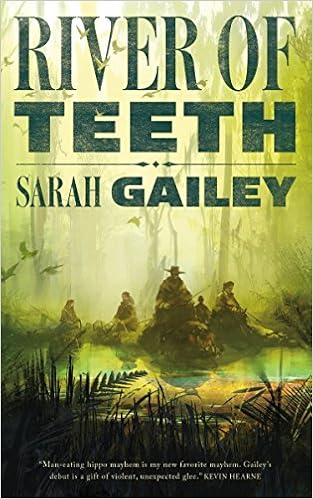
BOOK REVIEW: River Of Teeth by Sarah Gailey

written by David Steffen

Did you know that in the early 20th century the United States Congress considered a bill to populate the Louisiana bayou with hippopotamuses to serve as a new source of meat during a meat shortage?  In River of Teeth, we get to see an alternate history where that law passed and some decades later there are hippo-riding “hoppers” which are something like cowboys.

River of Teeth is a new release and debut novel by Sarah Gailey and published by Tor Books.  It is sort of a an alt-history Western with the feel of a heist story, and also a revenge quest, the first of a two-part book series.

The hippos have been in Louisiana for decades now, and enough hippos have escaped from ranches that the southern portion of the Mississippi River is avoided by most as it is inhabited by feral hippos.

The main protagonist of the story is Winslow Houndstooth, a hopper who had been very happy establishing a hippo ranch until he was betrayed and the ranch burned to the ground by his then-ranch hand Cal.  Now he has accepted a job from the government to clear all of the feral hippos out of the Mississippi so the river can be used again.  He is gathering a group of specialists to help him on the job, including Cal himself, and Houndstooth also has revenge on his mind.

The book has an ensemble cast of characters, several of which takes turns as protagonists, and most of which have their hippos as ancillary characters—each with their own personalities and distinguishing characteristics.  The protagonist’s goal is a daunting one—how do you move hundreds of hostile hippos out of their own territory with just a few hippo-riders?

Given the premise of the book I was expecting the genre to be something like bizarro or weird fiction, this took some mental adjustment for me because it was solidly alternate history.  I don’t think this was an issue with Tor’s marketing, because I don’t believe I really read any of their marketing apart from seeing Sarah post about the premise, and from the premise I assumed it was bizarro.  What I mean by the difference is that the book started with a weird idea (which it claims is a historically accurate weird idea that didn’t get approved), but otherwise plays the book completely straight—given the initial premise, everything else about the story is a consequence of that weird idea.

The book is full of action, lots of cool character interactions and deception, and has the feel of a heist plot (a subgenre I enjoy).  Lots of things to keep you guessing as to what’s going to happen next.  I appreciated that the main cast of those participating in the heist were pretty evenly gender-split, including a nonbinary character which I appreciated that representation, as well as gay characters.

On the whole, I enjoyed the book.  I was surprised at how quick of a read it was, and I’m looking forward to reading book two to find out how the story concludes.

DP Fiction #27B: “The Aunties Return the Ocean” by Chris Kuriata

Content note(click for details)

Content note: harm to children

Auntie Roberta landed badly on the roof of her escarpment house, scraping her knees across the flagstone shingles and splitting her pantyhose. Her arms were too full of black water to keep her balance so she nearly slid off the edge.

She carried so much ocean she barely knew where to hide it all. Inside her stony home, she filled the kitchen drawers and cupboards with cold dark brine. Every pot and tankard as well. She quickly ran out of places, yet her weary arms were still loaded with the stuff. Where would it all fit? Auntie Roberta got on her knees and stuffed the final bits of ocean into the mouse holes. She heard the panicked mice squeak before drowning.

What an exhausting evening she’d endured. At the appointed hour, all the Aunties of the world had banded together like a swarm of locusts, and set upon the heart of the ocean. Their grubby hands tore the water apart, breaking up the reflection of the moon as they scrambled to load every last drop into their arms.  All along the empty ocean floor, fish flopped and ships jammed into rock beds. The neighbours had called the Aunties’ bluff, refusing to give in to their demands. So, just as the Aunties threatened, they stole the ocean.

During the theft, Auntie Roberta kept close watch on the other Aunties, noticing none of her sisters carried away as much ocean as she did. Auntie Roberta always did more than her fair share and never received thanks. The other Aunties thought they were smarter than her, but really they were just lazier.

“Hey!” Auntie Robert shouted. “Get away from there!”

A burr covered cat with collapsed ears sat on the kitchen table, lapping away at a mug filled with ocean. Auntie Roberta flung a wooden spoon and sent the cat retreating through a gnawed hole in the parlour wall.

“Sneaky thief,” she huffed.

***

“It smells damp in here,” the neighbour woman Marilyn said. She didn’t outright accuse Auntie Roberta of helping to steal the ocean, but she certainly sounded suspicious.

Normally, Auntie Roberta threw rocks at nosey neighbours, but the neighbour woman Marilyn came bearing a freshly baked pie and, well, Auntie Roberta didn’t know any spells strong enough to compete with flawlessly executed baking.

“Roof leaks when it rains,” Auntie Roberta said, stuffing pie into her mouth with both hands. “Makes the house damp. Can’t do nothing about it.”

The neighbour woman Marilyn pointed to the ceramic mugs, each filled to the brim with a curious liquid the colour of midnight. “What’s in all these?”

“Coffee what’s gone off.”

The neighbour woman Marilyn put her nose to the rim and breathed in the scent of salt and seaweed, triggering memories of her uncle’s tugboat and the baskets of crabs she helped haul from the deep.

Auntie Roberta licked the last of the crumbs from the bottom of the pie pan and the neighbour woman took her cue to leave. A neighbour had nothing to fear in the house of an Auntie so long as she was eating, but once an Auntie’s belly was full, staying under their roof was like leaving your head in a lion’s mouth–sooner or later the jaw would get tired and CHOMP.

Auntie Roberta washed her sticky lips in a mug of the ocean, breaking up the reflection of the midnight moon that continued to shine from the still water.

***

Word of their victory reached Auntie Roberta in her rain barrel: “The neighbours have agreed to our demands. Therefore, return your section of the ocean back where it belongs.”

Auntie Roberta took stock of the ocean squirreled away all over her house and wondered how on earth she’d manage to carry so much. She couldn’t believe she had done it the first time.

“Looks like I’m making two trips,” she grumbled.

To distract her mind from the inconvenient task, she looked forward to the coming spring. At last, no more sneaking around or disguising her identity. No more inventing schemes to trick the offspring into entering her service. Thanks to the ocean theft, this year the Aunties could snatch up whatever offspring they desired and the neighbours couldn’t lift a finger in protest. It had been agreed.

***

The sight of the returned ocean astonished Auntie Roberta.

“Are we joking?”

The returned ocean sat miles below its original level. The water had gone off, turning grey as stale root-brew. Auntie Roberta saw all sorts of detritus swirling in the stunted ocean; cobwebs, bits of crayon, pocket lint, silky upper-lip hair… You couldn’t even see the reflection of the moon anymore. It was an embarrassment. The Aunties left the ocean looking torn apart as a robbed grave.

The original genius of their plan, having every Auntie take part (for how could the neighbours track down and punish a million Aunties?) turned out to be its greatest weakness, for while a dozen Aunties will be cunning and precise, two dozen will be absent-minded and deceitful. Harvesting the effort of every Auntie in the world? Good Lord. The neighbours ought to be thankful there was any ocean left.

***

The day after, Auntie Roberta lay on her roof, camouflaged beneath a blanket of shingles, her arms loaded with rocks to repel the invading neighbours she was sure were coming once they switched on the morning news and got a look at the mess the Aunties had made of their beloved ocean.

Not a single rock needed to be thrown. The angry neighbours never came. Instead of seeking retribution, the neighbours gathered together as a community and held a day of mourning for their once vital ocean.

No action would be taken against the Aunties. The neighbours would honour their agreement, terrified if they reneged the Aunties would rise up and do something even worse.

That evening, Auntie Roberta smelled fresh bran muffins and opened the door on the neighbour woman Marilyn. Auntie Roberta stuffed muffins into her mouth, famished after spending all day on the roof with nothing to eat but the occasional low flying sparrow.

The neighbour woman Marilyn lifted a mug from the kitchen table. A bit of the ocean remained inside: a mouthful’s worth. The neighbour woman Marilyn swirled the mug, making the ocean race around the ceramic walls like a fat, black worm.

“I’d never looked closely before at how beautiful it was,” she said.

Auntie Roberta kept quiet, unwilling to admit her involvement in the ocean fiasco.

The ocean in the mug retained its midnight colour, and when allowed to pool the reflection of the moon shone brightly, dancing on the wall like candle flame.

“May I keep this?” the neighbour woman Marilyn asked. “So that one day my grandchildren can see what the ocean used to look like?”

Auntie Roberta’s full belly made her agreeable, and she waved her hand generously. “I suppose so, on the condition of future baking.”

She watched the neighbour woman Marilyn carry the mug down the escarpment, clutching it between her hands, not wanting to spill a precious drop of the original ocean. Neighbours made a bad habit of deifying things. Such reverence for objects made them easy to take advantage of.

***

When an Auntie grabbed an offspring, they performed a series of alterations to make the offspring more compatible with their needs. Some were muted. Others had their limbs lengthened or shortened. A few had their eyes cut out in order to heighten their other senses.

Auntie Roberta modified her offspring by burning the hair down to stubble, compacting the feet into cloven hooves, and replacing the teeth with chunks of rock. This kept the neighbours from recognizing their darlings when Auntie Roberta sent them into town to purchase necessities. She didn’t mind the extra work. She re-sculpted the offspring so effectively that even if their mothers did recognize them, their mothers always let them go, correctly believing they were beyond hope.

For days, Auntie Roberta waited in vain for fresh baking. Because of the damage done to the ocean, the temperature soared and there was scarcely air to breathe. Few neighbours could make the trip up the escarpment. There were no more markets and all the stores were closed. The moon did its best to keep the tidal waves in effect, but the new handicapped ocean could no longer provide the neighbours with the luxuries they had taken for granted all these millennia.

Before the receiver in her radio went out, Auntie Roberta heard about the neighbours’ pitiful attempt to rehabilitate the ocean. They emptied the tank of every aquarium and science lab. They hoped these fish would adapt to the new environment. “Nature will find a way” was the motto. Over the next thousand years, the fish might evolve into new species–guppies the size of whales–that would clean the waters and make the ocean once again capable of reflecting the moon. No neighbour alive would live to see that day, but maybe the children of their grandchildrens’ children would know the ocean as their ancestors once had.

Auntie Roberta allowed none of this tumult to affect her. So long as her house remained protected and she had her latest offspring to aid her daily tasks, she could endure anything.

The other Aunties, however, decided the neighbours had suffered long enough, and so they began bartering back the other half of the ocean.

***

Auntie Balut came to visit, trekking up the escarpment on the back of her long-legged offspring. The sunburned beast of burden collapsed after delivering her master. Auntie Roberta found an old can of stewed tomatoes. She cracked the tin and slowly fed the convulsing offspring the life-giving water inside. The last thing Auntie Roberta wanted was for the offspring to croak. With no one to carry her down the escarpment, lazy Auntie Balut would declare herself a houseguest and expect to be waited on hand and foot. The trouble with Aunties was their obnoxious insistence on making themselves at home.

With her shoes off and her bare feet propped on the kitchen table, Auntie Balut showed off the fine jewelry swaddled six layers thick around her neck. “This here had been in the family seven generations. And this here? They actually had to break into the mausoleum to strip it off the body.”

All the Aunties were rolling in wealth, for each held back a parcel of the ocean, stowed away in a kitchen drawer or under the bed like an antique vase they were waiting to appreciate.

“I could ask for all ten of their fingers, and they’d happily slice ‘em off with one hand and then wedge the knife between their teeth to slice ‘em off the other.” Auntie Balut dumped a purse of chopped fingers onto the table to prove she spoke no hyperbole.

In these harsh times, a bucket of the original ocean went a long way, and so the Aunties made out like bandits. The neighbours learned to extract threads of algae and encourage new growth. They pulled tiny fish from the black depths, happy to see new schools spawned the next morning.

Most impressive of all, when the sun set and the neighbours’ pitiful hovels were cast in darkness, their bucket of original ocean reflected the bright full moon just as it had shined the night the ocean was stolen. Whole families from age eight to eighty circled the bucket, hypnotized by the twinkling light and fortified by the fresh air.

When Auntie Balut finished crowing about her recent windfall, she looked around Auntie Roberta’s kitchen and her mood turned dour. Auntie Roberta had no mounds of jewels or ancestral skulls or even piles of snipped-off fingers to attest to profitable negotiations for her share of the ocean.

“Oh sweetie,” Auntie Balut said. “Did it not occur to you to keep a bit of the ocean for yourself? You know, to make a little—” she rubbed her fingers together in the sign of filthy lucre. Auntie Balut threw her head back and cackled till she broke wind, relishing the embarrassed look on Auntie Roberta’s face.

“You put all your ocean back? What, was someone supposed to spell out what we were really up to?”

Auntie Roberta held her chin high, waiting for Auntie Balut to laugh herself out. Instead, the laughter and the insults intensified, turned mean. “Maybe you gave the neighbours ocean freely. Maybe you love them more than your own Aunties.”

When she’d had enough, Auntie Roberta retrieved her knife from beside the whetstone and went outside. On the lawn, Auntie Balut’s offspring slept heavily, full of tomato water and dreaming of its old life. Auntie Roberta swung her knife, ripping the throat open from ear to ear, effectively bringing the offspring’s service to an early retirement.

“Leave all your jewelry on the table,” Auntie Roberta said as she wiped her bloody hands on her apron. “That should lighten you up enough to carry your own fat ass down the escarpment.”

***

Ages had passed since Auntie Roberta last paid someone a visit, so she intended to do this one right. Instead of squeezing herself into a ball to roll down the chimney or gnawing her way through the tasty kitchen floorboard, Auntie Roberta clicked her heels together on the front porch’s WELCOME mat in a perfect parody of one of the neighbours. She even brought a gift.

“Good morning,” Auntie Roberta said, proudly displaying a tray of baking. She hadn’t the right ingredients for her cookies; mostly sand and flour made from crushed mice bones, held together with spit and tomato water. She decorated the tops with broken Christmas lights.

The neighbour woman Marilyn nodded, and ushered Auntie Roberta inside. She had shorn her head bald, and her dry skin wrinkled like an impression of an alligator.

“Is your husband at work?” Auntie Roberta asked.

“No,” the neighbour woman Marilyn said, casting her eyes to the bloodstained hole blasted into the wall over the couch.

“Too lazy, is he?”

The neighbour woman showed no interest in the cookies, so Auntie Roberta snatched a couple and tossed them into her mouth. The glass crunched and made colourful clumps between her teeth.

She cut to the chase. “Have you still got it?”

The neighbour woman Marilyn nodded. “Have you come to take that from me too?”

Auntie Roberta reached for more cookies. “Things freely given cannot be taken back. But there’s nothing to stop us from making a trade.”

“What could you possibly have to trade me?”

The last of the cookies flew into Auntie Roberta’s mouth. “Anything you’d like, so long as you’re not too greedy.”

“Too greedy?”

“Meaning ask for one thing, not a dozen.”

She licked the empty tray and tossed it into the corner. The ceramic shattered, sending white shards flying like punched out teeth.

The neighbour woman Marilyn closed her eyes. Praying? Thinking? After a moment of privacy, she nodded and said, “Come with me.”

Stuffed animals made a pyramid on the too-tiny bed. Auntie Roberta’s back ached to see a bed that small. She would have to saw her legs off to fit, and there would be no room for the occasional late night company. The heads of plastic dolls crunched beneath her feet. This was a gaudy, immature room.

The neighbour woman Marilyn reached beneath the bed, retrieving a lunchbox painted over with frolicking cartoon animals. The frivolous object offended Auntie Roberta’s sensibilities, but the neighbour woman handled it reverentially, as though it were part of a daily religious ritual.

She split the box open and removed the Thermos rattling inside. Before passing the pink canister to Auntie Roberta, she held it to her chest, resting the lid against her cheek. Auntie Roberta thought she looked ridiculous, like a chimpanzee fooled into accepting a surrogate dolly.

“At night, I’d unscrew the lid, and moon light would cover the ceiling. We used to lie on our backs and watch the light ripple. She said it looked like friendly ghosts.” The memory pained her, and she thrust the Thermos towards Auntie Roberta. “It sings to me at night, begging to be let out, but I’m afraid it will evaporate and I’ll be left with nothing.”

“Relax, I’ve handled ocean before.”

At the front door, with the Thermos tucked snugly into her apron, Auntie Roberta lingered, about to suggest the neighbour woman continue to visit her little house on top of the escarpment. She could bring fresh bread, baked on the rocks in her yard. Neighbours often made feeble attempts to befriend Aunties, either out of awe or fear, but such partnerships were forbidden. This was a new world, however, and Auntie Roberta didn’t feel like she needed to play by the rules anymore.

She turned back, about to extend an invitation, but changed her mind. The light in the neighbour woman’s eyes, dim when she first arrived, had now gone out completely. She was a woman without hope, and Auntie Roberta knew she would never see her again.

***

Using steady, freshly licked fingers, Auntie Roberta poured the ocean into a hollow glass amulet the shape of a spider with its legs ripped off. She sealed the amulet tight and hung the chain over her neck. Ice coldness stabbed her breast and she shrieked. Unexpectedly, the ocean remained as cold as it had been the night the Aunties scooped the water up.

“You’re a tenacious bugger,” she saluted the ocean.

The heavy amulet swung from her chest proudly. No Auntie could laugh at her now, like stupid Auntie Balut had done. The ocean around her neck proved she was just as devious and cunning as the lot of them. She couldn’t be mocked—just so long as the embarrassing truth of her giving the ocean away to a neighbour woman (and having to pathetically make a deal for it back) stayed secret.

“I didn’t trade mine away for useless trinkets. I still got my piece of the ocean.”

All that was left now was for Auntie Roberta to fulfill her end of the trade between her and the neighbour woman.

“It’s a goddamn shame,” Auntie Roberta said.

The offspring stirred at the sound of her approaching footsteps. For practical purposes, Auntie Roberta kept the offspring crated beneath the basement steps when she went out. So much easier than worrying what mischief they were getting up to in her absence.

Auntie Roberta paid dearly for the return of her dignity. She knew this offspring was the last she’d ever have in her service. Without the ocean, the land was mute of the sound of copulation. Neighbours were unwilling or unable to create future offspring.

“I promised your mommy a strange mercy.”

Auntie Roberta slid the block of wood from the crate door. Her apron held the same knife used to cut the throat of Auntie Balut’s offspring. Used properly, it would do the job just as the neighbour woman Marilyn had demanded:

“Release my daughter from your service, quickly and painlessly,” she had said.

She must have thought Auntie Roberta would use a spell, giving her daughter a final dream of their happy family on a clean ocean before magically stopping her heart. Charming, that the neighbour woman thought spells came as  easily to the Aunties as snapping their fingers, but no. Auntie Roberta wasn’t going to waste the effort of a spell on the offspring.

“Come to Auntie.”

The offspring remained in the cramped crate. Normally so eager to get out, this time they crouched on their elbows and knees, eyes opened wide. Monkey noises came from their throat, contractions that normally turned into… what, cheers? Laughter?

In the darkness of the basement, the reflection of the moon beamed from Auntie Roberta’s amulet, shimmering over the steps, filling the crate with its cool, blue light.

“Oh, you like that, eh?”

Auntie Roberta lifted the amulet. The reflection of the moon brightened the clay wall. The offspring rolled onto their back, looking up at the light as it rippled and twinkled, dancing across the wall like friendly ghosts. Purring softly, the offspring threaded an arm into the dirt, cuddling the imaginary mommy tucked lovingly beside them.

Auntie Roberta twirled the amulet between her fingers, sending the moonlight gleaming all over the basement. She hated her sisters, the rest of the Aunties. Since the inception of the universe they had a glorious, renewable pool of fresh neighbours that provided them with everything they needed to survive. And they’d fucked it up irreversibly and for what? A fleeting moment of superiority? Untold riches for the cleverest of speculators? Well, that worked out just great, hadn’t it?

“What a goddamn shame.”

With the last of the shimmering ocean lying cold against her breast, Auntie Roberta pulled the knife from her apron and held up her end of the trade, completing the task faster and more mercifully than any spell she might have cast.


© 2017 by Chris Kuriata
Chris Kuriata lives in St. Catharines, Ontario. His short fiction about elderly poisoners, whale-hunting clowns, ghastly family photographs, and childhood necromancy have appeared in many fine publications. You can read more about his work at www.chriskuriata.wordpress.com


If you enjoyed the story you might also want to visit our Support Page, or read the other story offerings.
MOVIE REVIEW: The Lobster

written by David Steffen
The Lobster is an internationally-produced 2015 dystopian black comedy film.

In the near future, all adults in society is expected to be in a long-term relationship and violation of this expectation is illegal.  If you find yourself single you are required to go to a special hotel where you have forty days to find a new long-term partner.  If you haven’t found a partner at the end of forty days, then you will be turned into the animal of your choice (or if you have violated other rules, the animal you would least enjoy), where you will have another chance at romance in the animal kingdom.  You can’t just partner up frivolously, either, you have to be able to demonstrate a major thing that you have in common.  Residents can gain extensions to their stay by hunting and tranquilizing single people on the run in the woods.  (There are other rules, as well)

David (Colin Farrell) discovers that his wife has left him for another man and he is brought to the hotel at the start of the movie, with his dog (who had been his brother) in tow.  He quickly befriends a couple of other men and sets out to find a woman to partner with.

This movie is incredibly weird, in turns bleak and hilarious.  The movie is largely built out of awkward silences in the various odd situations, and the movie throws you right into everything without explaining anything so you have to figure out much of the premise for yourself as the movie goes on.  I highly recommend it for anyone who likes a puzzle or who likes dark comedy or weird worldbuilding.


THEATER REVIEW: Animaniacs Live

written by David Steffen

Animaniacs was a comedy cartoon show produced by Steven Spielberg that ran from 1993 to 1998, first on Fox, and then on the WB. It was set up as a variety show with several short skits per episode starring different casts of characters–the most often recurring being the Warners: Yakko, Wakko, and Dot who live in the water tower on the Warner Brothers studio lot.  The show was most known for clever and funny songwriting as well as humor that was meant to appeal to adults as well as children, often making jokes about Hollywood.
Animaniacs is back in the form of the live show Animaniacs Live.  Voice actor Rob Paulsen and songwriter Randy Rogel headline the show, with special guest.  You might not immediately recognize those names, but if you watched Animaniacs you’re already familiar with their work.  Rob Paulsen played the roles of Yakko, Pinky (of Pinky and the Brain), and Doctor Scratchandsniff–he has also done voice acting work for other cartoons, see his website for more information.  Rob Rogel wrote many of the songs for Animaniacs, including Emmy-winning “A Quake! A Quake!”.

We saw the show in Saint Paul, in a pilot showing on April 9th–the first official show was in La Mirada CA April 15th.

Looking at the product page for the La Mirada show I think that the production of the pilot may have been very limited compared to the full show that will be on tour.  What we saw had 2-3 people on stage and a piano, and a projector screen above the stage.  Rob Paulsen sang, Randy Rogel played the piano and sang, and with the special guest most often providing harmony.  The projection screen was used about twice during the show–once leading up to to the show, and once to show a song later on.  The La Mirada ticket page shows a symphony onstage, so it sounds like there might be quite a bit more going on in the official tour.

So, I don’t know how the full production affects the format of the show–maybe it’s the same general format, just with more musical performers.  The show that we saw alternated between talking for a few minutes about the show and then leading into musical numbers.  They sang some of the more well-known songs from the show, so you should be able to sing along with those.  They also included some alternate endings to songs that Rob Rogel submitted and was asked to change, as well as at least an entire song that didn’t make it on the show.  They also talked about the creative process, how a song goes from his composing studio to the screen, about what it was like to work on the show, about other projects they’ve worked on, and so on.

I love seeing voice actors whose work I know in person because it is so strange and exciting to hear the voice you know and love coming from a completely unfamiliar face.  For that alone the show is worth seeing, and the extra material like changed endings and cut songs and commentary make it sort of like a live show of DVD extras about the TV show.  If you liked Animaniacs, odds are good you’ll like the show.  If you’re not familiar with Animaniacs, but you like funny songs and live performances, odds are still good you’ll like the show.

One thing that wasn’t really clear to me from the marketing leading up to the show was:  is the show intended for kids?  We brought a child to the show, thinking that they would be performing the songs live while they projected the cartoons on a screen.  The show wasn’t really set up for kids that age–sometimes-long segments of talking between songs, and almost no showing of the cartoons.  Again, we didn’t see the full show, so maybe they use the projector more during the official run which would probably get kids more into it, but at least the version we saw it was difficult for a kid to sit through.

They also had a Q&A session after the show where they would take questions from the audience.  Which sounded wonderful, but we decided we needed to leave, rather than subject the kid to any more waiting.  I’m not sure if the Q&A will be a feature of all their shows or if they were using the pilot as a way to gather some more questions they might ask during the show itself.

I’ll be interested in seeing how the show does as a whole, and hearing what the full show is like that apparently has the live orchestra and etc.