written by Frank Dutkiewicz
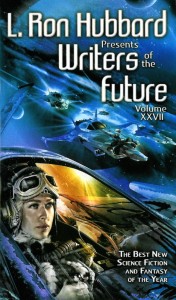 This marks the fourth year in which I am reviewing the Writers of the Future contest. As a long time reader (I bought Volume I when it came out), and frequent submitter of the past few years, I have come to appreciate the work K D Wentworth and her predecessors have done putting this mammoth endeavor together every year. In the past, I’ve read issues and thought I can do better than that. It wasn’t until I started writing did I realize it wasn’t as easy as it looked. When I started reviewing, I had begun to marvel the work the authors put into each story.
WotF #27 marks the beginning of a new era for the anthology, electronic submission. The contest has done their part to save a good-size tree, to the detriment of the post office. However, although the contest isn’t sharing how much, free mailing likely means an increase in submissions.
This issue has 13 stories for us to enjoy. 12 winners and one writer who’s still qualified to win a future Gold Award (lucky slob). So how are they? Let’s find outâ€
“The Unreachable Voices of Ghosts” by Jeffery Lyman 2nd place, 4th quarter.
Max Getty is a sail-ship fisher. His sails ride on the solar wind while he fishes for the mini-black holes needed to power the engines of starships, in an area of space way beyond the orbits of the outer planets. Max was once famous, but has turned his back on humanity. The crowded inner system and suffocating public had been enough for him. He seeks the solitude of isolation, vowing never to speak to another human again.
But divorcing yourself from humanity is never a clean break. Max still monitors the radio traffic between fishermen. Kingfisher’s constant rambling over the waves is comforting. He listens to announcements from other fishers as they ‘check out’ for the last time, while tracking others in his neighborhood – his closest neighbor, a million miles away. Then disaster strikes, forcing him to break his vow of silence and ask for help.
Help arrives in a vid sent from a fisher named Maureen. Like other fishers, she has had enough of humanity, escaping from its confinement and running from past mistakes. The distance between them is so far the time lag is 16 minutes for their messages to reach each other. They are millions of miles apart but Max hasn’t felt this close to another in decades.
“The Unreachable Voices of Ghosts” is “Robinson Crusoe” with a ham radio. The story is set in a background of a crowded solar system. Hundreds have escaped to its edges in the search of the mother load. The trips are one-way for most. Many succumb to the isolation, choosing suicide in the end. The story takes the shape of a depressing romance early on. Max’s belief that he wants nothing to do with people evaporates almost immediately as soon as Maureen comes calling. However, like many romances that spring up in today’s internet world, the long distant suitors hide secrets about themselves.
A lot of good science fiction are tales that explore the people we are today in settings of tomorrow. Mr. Lyman created a very plausible premise, a way out for the agoraphobic of a crowded future. Max is a man in mourning, acting out in an extreme fashion. I had problems with a few points in the piece. I believe a sudden influence of G’s would be devastating to anyone living in a zero-G environment, as one example.
This tale explores how much of a social animal we really are, even when we want nothing to do with humanity anymore. The story and setting captured my interest right away, but I began to sour on it expecting a depressing conclusion. I can safely say the ending ended up satisfying me after all.
“The Unreachable Voices of Ghosts” is just the type of story I look forward to when I buy my copy of WOTF every year.
Grade A,
“Maddy Dune’s First and Only Spelling Bee” by Patrick O’Sullivan 1st place, 4th quarter
Maddy Dune has arrived at the St Anselm Orphanage with her array of morphed animal family members. The Bee is for the up and coming spellmakers. Maddy’s entrance is unusual. Half-beasts like her are curiosities. She befriends a cabinet, who is her closest competitor, and searches the audience for her adoptive parents who rescued her long ago.
“Maddy Dune” is an intriguing fantasy. By the title, I was expecting something different. Very clever. Maddy proves to be a formidable speller, frightening half the audience into fleeing with her first illusion. Her immediate family is an arrayof pets , brother, a raven and sister as a cat , it made me wonder what Maddy really was (a question that was never answered). She assumes that she has angered her adoptive mother, Nadine, believing it to be the reason why her stepmother broke her promise to attend the bee. Tan the Cabinet soothes her, assuring her that her parents are likely proud of her and will keep their promise in the end.
This is a tale that was easy to fall into. There were many characters to keep track of but most served as background for this complicated tale. The real story focuses on Maddy and Tan. Tan is mesmerized by Maddy, forming his spells with her in mind.
Deeper into the story, the tales complicated plot takes a twist, confusing to the point where following along gets dizzy. Piecing together what is happening becomes a chore, turning this wonderful tale into a reader’s project. Particularly delightful is Maddy herself. Mr. O’Sullivan brought to life a character who is likeable and convincingly talented. The parts of the tale with her conjuring spells was writing at its best.
Considering the previous story was submitted in the same quarter as this one, I can imagine the judges had a difficult time choosing which one was better. My vote would have been different but nevertheless, this story was well deserving of its first place finish.
Grade B+
“The Truth, from a Lie of Convenience” by Brennan Harvey first place, first quarter
Marianne Summers is a freelance on-camera reporter. Older, discredited, she jumps at a job covering the five-year memorial of the Luna City terrorist attack on Habitat 14. The job is simple: film Thomas Rubner, husband to Susan , one of the council members who died with 6000 others that day , while he lays a wreath at the memorial. Thomas ruins the script when he uses the event to espouse his belief that the attack was orchestrated by the government.
Marianne equates the Habitat 14 conspiracy as she does 9/11, the Kennedy assassination, and countless others in history, a bunch of bunk. But when the security forces report a lie of Thomas committing suicide at the memorial, Marianne’s reporter instincts kick in. She is out to discover the truth, but has two problems of getting to it. No one on the moon wants the truth and no one on Earth cares.
“The Truth” has the flavor of a futuristic mystery. The tale follows along while Marianne attempts to investigate what happened after Thomas Rubner inexplicably fell off the script. Thomas claims that his wife didn’t die in the explosion five years before. That she and other council members were rescued. Marianne finds it hard to believe that the government would willingly destroy a priceless habitat, and kill the innocent people inside, but the terrorists demands were met , independence from Earth , as a result of the disaster. Her attempts to follow up on the events of the memorial are blocked by the security forces, raising her suspicion. Then while following Tommy’s body, as it is about to be loaded on shuttle back to Earth, she runs into a person who should be dead.
Much of the story is about Marianne trying to become relevant as a reporter again. A smear by a former employer has made her almost unemployable. She knows the story she is following is huge but can’t get any support from her temporary employers Earthside. Evaporating funds and a hostile law enforcement have left her with few options. She has few friends to turn to in Luna City, and the security force knows it.
“The Truth” is a strong tale. Mr. Harvey created a character so easily identifiable in today’s world and set her in a believable future. It isn’t too difficult what spawned the idea for this story. Conspiracies have become ingrained in our society. This story dives into what I consider a human frailty, a desire for many to believe that there is always more than meets the eye in every event. Unlike the circumstantial leaps of faith modern day conspiracies draw their life from, the Luna City conspiracy has solid evidence any law enforcement agency could poke holes into, even from afar. I found it difficult to believe the disaster would have resulted in independence instead of a more solid Earth authority presence. In short, the inability to uncover what Marianne did years later is a frailty in this plot.
Aside from that small nit, I thought this story was solid. The writing, pacing, idea, and conclusion fit well in the type of story that I like. I was always expecting a twist to pop up (must be a conspiracy) but Mr Harvey kept the storyline straight. A good tale told by a solid writer.
Grade A ,
“In Apprehension, How Like A God” by R.P.L. Johnson first place, third quarter, Gold Award winner.
Detective Conroy investigates an unusual death at the reclusive Academy. Magister Musoke exploded while working alone in an isolated workshop. The Arch-Mage of the academy concludes by the complicated steps necessary for the accident that Musoke committed suicide. Conroy finds an illegal drug in Musoke’s room, something unthinkable for a monk of the academy. With his only lead, Detective Conroy searches for the drug dealer who supplied Musoke, and in the process, unravels an even greater mystery.
The setting for this futuristic tale is in a bustling Entebbe with a space elevator dominating its skyline. Within this future Ugandan city is the Academy, keeper of the aethernet , the all encompassing data storage and delivery system intertwined in society. Nodes , small rolling balls that are Limited Intelligent units , accompany the programming monks. Magister Musoke was working on improving the nodes, making them capable of perceiving and compiling data on their own, or allowing them to become self-aware. Detective Conroy is greeted by one such node named Stromboli, an assistant to Musoke.
The investigation moves quickly and turns sharply when Conroy’s person of interest turns up dead. The method of death is just as gruesome as Musoke’s, and is also ruled a suicide. Whatever is happening is either a curious set of circumstances, or a conspiracy far greater for a lowly detective to solve.
“In Apprehension” is a story cut from the cloth of “Blade Runner.” The future in this tale has a dark flavor to it. The aethernet has become a part of us, connected to our senses and embedded into are brains. It has the capability of altering what we see and smell. Drugs of this future further this sensory disconnection. The world sounds like a tough place to soak in, which may explain why some want to tune out.
The details of this surreal place are done well by Mr. Johnson. I thought his attention to providing a picture of his future to the reader, was similar to what Alastair Reynolds does with his dystopia futures. I found the main character very likeable. Couple him with the author’s ability to bring a unique and rich future to life and you can see why the judges chose his story as this year’s winner. I however, wasn’t as taken in with it.
Mr. Johnson’s long departures from the story to provide behind the scene details for the reader left my head swimming. A couple of times, I had to stop reading and backtrack just so I could regain some clarity to what was happening. As a mystery, the tale doesn’t work as well. I thought Detective Conroy jumped to conclusions based on assumptions alone. In fact, I would say the things he got right were at best lucky guesses.
Nevertheless, once you manage to get grounded in this difficult to soak in setting, there is a very good story in “In Apprehension.” Not my favorite tale, but I can see how it would be for fans of dystopia-like futures.
Grade B
“An Acolyte Of Black Spires” by Ryan Harvey 3rd place, 1st quarter
Quarl researches for his Artikon masters. He is an acolyte, one of a few whose goal it is to search through the history books, looking for answers to the Sorrow that inflicts the Eldru race. Like many who suffer from the Sorrow, he is an introvert, preferring the company of his rodent pet over Eldru and humans. He dons a mask while in the presence of others , the Sorrow making it necessary so his face doesn’t overwhelm others inflicted with the condition. Quarl’s superiors are satisfied with his research and have decided to give him an assistant. He is uneasy with the idea with working with another, but finding worthy volunteers to assist the Acolytes of the Black Spires is rare.
Hallett is unlike any Eldru acolyte he has known before. He is encouraged by her eagerness. His jehol pet has taken an instant liking to her. Quarl pushes down a nagging suspicion he feels for his acolyte protÃÆ’ ©gÃÆ’ ©. She shows an interest in him and asks for the unthinkable , to see his face.
“An Acolyte of Black Spires” is a strong character driven story in a murky speculative setting. Quarl is convincingly reclusive. The tower he lives in is more of a high security prison than a facility of higher learning. He seems content in his existence, so much so his superior says he doesn’t feel his Sorrow, a statement that has a negative connotation meaning to it. Hallett’s entrance to the story brings out feelings he has suppressed.
While I found the story between Quarl and Hallett intriguing, the background tale of the world they lived in, left much to be desired. Questions of what the Sorrow was, how the Black Spires and Quarl’s job as a historian could end it, or what the Eldru were, were left unanswered. I couldn’t get a grasp of what the problem was to care if it was solved. The story itself went on a bit too long. I found the ending scene anti-climactic and wondered if it was really needed at all. Complicating my enjoyment of the piece, the twist two-thirds of the way through was a complete blindside.
“An Acolyte” was a demonstration of how strong writing can carry an incomplete plot. Fortunately, the bright characters carried me through a hazy story enough to look favorably upon it.
Grade B ,
“The Dualist” by Van Aaron Hughes 3rd place, 2nd quarter
Thomas McFall is Earth’s envoy to Phrentyr. The world is recovering from its latest, and deadliest, religious war. The nuclear travesty it has experienced has devastated the planet, all but eliminating the Tokhin , believers of the Two Gods. Only Earth’s threat of a withdrawal of aid keeps their rivals, the Solarans, at bay. Thomas aims to save the Tokhins and their culture, but the few left appear to be not interested. Billions of dead Phern and a crop killing moss, a byproduct of the nuclear winter, has failed to cool the hatred between the two cultures. Death of their race is preferable to reconciliation for the Tokhin, and Hirokh , Chief Enforcer for the Solaran , agrees.
Thomas accepted the impossible task of envoy, hoping this recovering world would help him find solace. His wife was brutally murdered back at Earth , a very rare crime these days – but he is mistaken to believe the Pherns would share his grief. Despite the devastation wrought by a difference in dogma, the Phern are not through with their violence to one another. Thomas even admits to himself that the Tokhin are not victims of a genocidal war, just the losers of one. But he learns that not all are eager to give up all hope. If one Phern is willing to move beyond the ancient hatreds, than perhaps there is hope yet for their world.
“The Dualist” is a tale that parallels humanity’s own violent past (and present). The two races of Phern’s hatred runs so deep it smothers all attempts at reconciliation. The few remaining Tokhin have been penned inside a ghetto called Doubletown. Thomas hopes encouraging the Tokhin to rebuild their temple will spark their will to go on. But the Sha’ad Tokn, a sacred stone, is missing and assumed destroyed. If Thomas can revive their hope, and their temple, he can save a dying race.
Of all the writers in this anthology, Mr Hughes skill for the penned word stands out the brightest. For the first two-thirds of this tale I was completely taken in with it. He framed an excellent premise, wrote engaging characters, and brought his setting to life for me. I believed I was reading a WotF masterpiece, then it all fell apart.
The back-story of Thomas’ own personal tragedy was a distraction, as if it was needed for Thomas’ motivation to succeed. Wouldn’t saving a race and culture from extermination be enough? I also found it unlikely that Earth’s choice for envoy would be a person harboring psychological scars. Even his alien counterparts were aware that he was unstable. I can’t imagine that Thomas’ superiors would be blind to his shaky stability.
I will not expose the ending so not to spoil it for those who haven’t read it, but I must say the twist in the final scene did not work for me. I found it to be a cheat in the premise.
The quality of Mr Hughes writing alone makes him deserving for a spot in this anthology. The fact he is so good, and wrote a story I liked most of the way through, earns him a favorable grade from me.
Grade B
“Bonehouse” by Keffy R. M. Kehrli 3rd place, 3rd quarter
Chris is an Evictionist. He infiltrates bonehouses to retrieve the people plugged into a netdream. He does it for a fee, and the fees are paid for by loved ones, broken-hearted souls eager to save the people they knew from wasting away to skin in bones. The addicts are hooked into an electronic life in cyberspace. Chris is after a hopeless addict named Laura. The fee is small, and he knows she will be back into a bonehouse once she recovers in rehab, but she is just a small fish on his way to a bigger catch.
“Bonehouse” is set in a bleak future in the Pacific Northwest. Rising oceans and an exploded Mt Rainier has devastated Washington State. Many have chosen to escape into cyberspace, their bodies sustained intravenously with vitamins while their minds exist in an electronic reality. They congregate in bonehouses, aptly named for the users who degenerate into atrophy. Chris is a futuristic bounty hunter. He was once locked into a netdream. He is on the hunt for the most wanted man in the Evictionist community, Cameron Trexel.
The road to Cameron takes Chris to a former lover’s home. Hints of his dark past are all over David’s home. Chris knows he is close to his biggest catch but will he be able to overcome addictive tendencies that have never left him?
I really enjoyed the setting Mr Kehrli framed for me. It did help that I happened to be traveling in the very areas in which he wrote. Envisioning addicts withdrawing from the real world for a virtual one is a problem I believe would exist today’ if it were possible. Particularly jarring for the addicts is when they are yanked from cyberspace. They have become living corpses, unable to walk, move, or care for themselves from months and years of laying in a coma like state while their minds live an addictive life. A very real future possibility indeed.
A story I found strong with a premise I could easily envision, unraveled for me halfway through. I had trouble understanding why Cameron was such a bad guy. A vague notion that he was a cyber terrorist was touched upon but he came off more as a modern day drug runner to me, and the drugs addicts are addicted to is available to anyone with a little bit a power and ability to access the web. The opening had Chris as a really tough guy, something like a Steve McQueen no-nonsense bounty hunter. The further I read, the less I knew about him. At one point, I wasn’t even sure Chris was a ‘him’ at all. By the end, Chris proved to be not so tough and the bad guy was hardly frightening.
Because of the premise and engaging beginning, “Bonehouse” is a story that could have received my highest of praise. But the high-octane first half sputtered before the end. This is a world I would like to see more of.
Grade B
:This Peaceful State of War” by Patty Jansen 1st place, 2nd quarter.
Miranda Tonkin is Solaris’s envoy to Bianca. The world is in the midst of a genocidal war. The Pari are a gentle yet resourceful race, capable of building architectural works of wonder with the simplest tools. The Hern’s only purpose in life is to hunt, destroy, and kill Pari. Wide tracks of ashes are the only thing left of Pari villages. The Universal Church’s missionaries have separated the two sides and are attempting to negotiate a permanent segregated settlement. They are the only thing preventing total annihilation and are requesting Solaris intervention to stop a massacre.
Miranda lives in the sterile confines of a low G space station. Planets are torture to her. She needs crutches to walk in the full G environment. Her body is atrophic and bloated. The Planet is a green world with a high oxygen content, so high projectile weapons are as dangerous to their user as they are to the users target. The world lacks carbon. Life has developed on a foundation of titanium. Bianca is very different than Earth but the Universal Church insists the Pari and Hern are human. They are out to prove the existence of god, and god made humans in His own image. Only humans can be sentient in their eyes and they are convinced Bianca’s inhabitants are brothers and sisters to Earth’s children.
“This Peaceful State” is compiled as a mystery. The missionaries have ceased to be objective. The Pari are like trusting children. They are capable of so much yet are docile to the point where they won’t protect themselves from the Hern. The Hern are unreachable. Miranda quickly becomes sympathetic to the church’s position but things have degraded to the point where an occupying force will be the only way to stop a complete genocide. She digs up past expeditions and discovers the Pari were more communicative in the past. The Hern were fewer in numbers as well. Miranda’s escort, Brother Copernicus, fears the churches interference has created this problem. Miranda can feel the answers to this un-Earth-like world, are close. Perhaps a simple Earth-like reason may be her answer.
Good sci-fi, in my book, are creations of possibilities I have never dreamed of before. Ms Jansen hit this mark in spades for me. Non-carbon based lifeforms are almost always ammonia in nature. Using titanium I thought was brilliant. Inserting missionaries conflicted with their beliefs also worked well in my opinion. The author deserves the highest praise for her well thought out setting. Bravo.
What keeps me from giving this piece my highest grade was the use of the protagonist. She had little to do with the resolution of the problem. She relied on past expeditions to piece it all together, and by time she did, it was too late anyway. The ‘problem’ resolved itself in its end. Her presence changed little.
Despite my complaint about the protagonist, I thought “This Peaceful State” was well deserving of its first place finish. After reading this tale, I now know why I see Ms Jansen’s name in a lot of publications these days.
Grade B+
Sailing the Sky Sea by Geir Lanesskog 2nd place, 3rd quarter
ÂVic Basilone’s life aboard a sky mine, riding on the swift clouds of Uranus, takes a turn when a missile strikes the platform and sends him freefalling into the dense atmosphere. Falling off a platform usually isn’t a problem, the danger of Uranus’s interior heat is a four-hour drop, but hopes of a rescue were blown sky-high with the platform. His luck changes when a portion of the station falls near him, and someone inside is manipulating the morph metal to slow the stations descent.
“Sailing the Sky Sea” opens with a bang. The station in which Vic works, is a victim of an opening salvo in a war between Mars and the Asteroid belt. He considers himself lucky that he was working outside when the missile hits, and even luckier when a portion of the platform falls close enough for him to climb aboard. But his luck may be short lived. The platform is still falling and power to it is running out. Rescue is a dim hope but the only hope left.
Vic enters the saved portion of the platform and finds two women doing all they can to survive. Kyla is a nurse and an assistant to a rich Venusian. Moor is a Martian and former soldier. Moor has been doing her best to hold the platform together while Kyla tries to keep her gravely injured boss, and his two business partners, alive. The trio work feverishly to save themselves. Moor and Vic must work together to keep the platform in one piece, stop its fall, and steer it to get a Venusian sky mines attention for any hopes of survival.
The premise to this tale is a wild ride, for the characters and the readers. Mr Lanesskog wrote an exciting sci-fi tale. I do not know if the physics of his story were possible but he had me believing that they were. In a short amount of space, the author wrote an extraordinary – yet buyable , future, with compelling characters and a problem that was unique and difficult to solve. This story was science fiction at its best. Poul and Niven would be proud.
My only nit was a brief ending that read corny to me. Could be just me, or it could be that I searched too hard to find fault with a superiorly written work of speculative fiction, but it was enough for me to not consider it perfect.
Grade A
“Unfamiliar Territory” by Ben Mann 2nd place, 2nd quarter
Mira is a security officer aboard an Empire company space station. Her boss, Harlan, wants her to intercept a company vessel that is failing to respond. Mira can’t go without an engineer, her boyfriend and longtime engineer died in their last trip. Harlan has one for her, a wide eyed intern from Earth. Rose is sweet, caring, and a bit squeamish , qualities not suited for a spacer. Mira wants nothing do with Rose but an engineer is necessary for her to do her job, and her job is all Mira has.
“Unfamiliar Territory” is a mystery set in future where space is run on the same set of rules that governed the 18th century seas. The non-responding Lumen has decompressed and her crew is dead. It has all the signs of piracy except most of Lumen’s cargo is intact. Shortly after intercepting the Lumen, Harlan radios her to intercept another vessel. This time one crewmember is found alive, in his suit, outside the vessel. The stress of a harshness of space is beginning to wear on Rose while Mira’s own skin becomes thicker. The surviving spacer is near death. A competing company vessel is close enough to ask for assistance, but asking for it is frowned upon and rarely welcomed. Suspicion runs deep in space, and there is no such thing as a friendly ship.
I found the tale, like many of the others in this anthology, rich in setting. I also thought the premise of a rough and you’re on your own attitude of space intriguing, but unlikely. Operating in space is an expensive endeavor, and I can’t imagine it would ever get cheap enough to allow cargo to get stolen, or people to get murdered, without a concerted effort to stop it. It appeared to me Mira’s job was more of an enforcer suited for today’s mob, rather than a rescue and recovery specialist. Rose is a girl in a tough spot. Mira makes it plain to her she isn’t wanted, as she is thrown into a dangerous and harrowing mission.
Mira is a hard woman. She is so unsympathetic she becomes angry when Rose’s compassion resurrects an old soft spot in her for a brief moment. She has survived on a notion that space is unforgiving and hard, and life is cheap. No one is your friend, which makes Rose’s inquisitive and naÃÆ’ ¯ve disposition that much harder for her to take.
As I said before, “Unfamiliar Territory” is a mystery, but a mystery that wasn’t solved in my opinion. The climactic scene was confusing. I had no idea what was going on, or why it was happening, during it. It pains me to say this, because Ben is a friend of mine (thanks for the book prize, buddy), but if he passed this one by me, I would have insisted he change that climactic scene if he expected this story to stand a chance. Good thing for him he didn’t. But nevertheless, unresolved mysteries and confusing premises are not stories that I remember warmly. The story was, however, a dynamite tale for the first two-thirds of it. That reason alone earns it a favorable grade.
Grade B-
“Medic!” by Adam Perin 3rd place, 4th quarter
Sergeant Tom Silk is the best damn medic in the army. He waits underground until he is called, surfacing through the rocky ground to retrieve the gravely injured. The sergeant is a hardass. He is rude, doesn’t want to hear a ‘thanks’ from the soldiers he saves, and is anything but respectful of the officers above him. He just wants to go home. Save five more lives and home is where he will be headed.
Silk wants to get home to his fiancÃÆ’ ©e waiting for him on Germonium. She is a colonist. The military is wary of all colonists and stand in his way to marry her. Denied, he does the unthinkable to the man who tells him no. Threatened with imprisonment, Silk’s skill as a lifesaver grants him a second chance with a choice that most would consider a prison sentence, save 1000 lives and he can go home.
“Medic!” is the story of a man filled with resentments. He is angry at a military that denied him a marriage with his love. Angry at the conscripts who have loved ones and flaunt it. Angry that his girl hasn’t written to him in years. Tom has lost his compassion. He views wounded soldiers as currency for his ticket out of the war and officers as nothing but easy marks on the poker table to him.
There is something to like about Tom Silk. He is a jerk of the first degree. I found his sarcasm funny and his look on the military amusing. However, a protagonist who starts off a loveable jerk ends up turning into dangerous man with issues. Tom proves to be a man who has lost much of his humanity. Any compassion I had for him went out the airlock halfway through.
“Medic!” is a story that would have fit well in many of the short science fiction stories I fell in love written in the 70’s. I found it a paradox that I would like such an unlikable main character.
Grade A-
Â
“Vector Victoria” by D. A. D’AmicoÂÂ 2nd place, 1st quarter
Victoria dances and mingles on the receiving pellet platform to Las Vegas. She greets arriving passengers with friendly kisses and wet willies. Forward, but it’s how she prefers to save the world. What better way to spread the viruses to counteract the government’s clandestine inoculation directive?
Victoria is a vector. A longtime activist for many protest movements, she has hitched up with Shamus. Shamus has been self-infected with a gene-tailored virus and has recruited the noble Victoria to help him. Together, they infect the populace, canceling out the FIT agency’s inoculation efforts. Shamus has been telling her the government wants to control the populace with their bug. Spreading the virus is the only thing that will stop them. She believes him, and always has, until a man enters the platform spreading his own set of germs that cancel out the virus.
“Vector Victoria” is the story of an ideological girl who wishes to do good. Victoria has been operating on the belief that the people in power are out for themselves, and are against the common man and helpless planet. Shamus is a man who she always believed in. He talks to her like a person rather than a bimbo. Although she doesn’t understand what the virus does, she believes what she is doing is saving lives. Until Artie appears.
Artie works for the government. Through their enhanced vision, Victoria and Shamus can see the germs he spreads. Artie knows all about Shamus. He has a different story on what kind of man he is. For the first time, Victoria doubts her hero. She must decide for herself if she has been playing the role of world saver, or has been used as an unwitting pawn for something sinister.
“Vector” takes the angle of a naÃÆ’ ¯ve girl. Victoria is a good soldier, who discovers she may have been fighting on the wrong side all along. The story starts off with a great perspective of an activist happy that she is living in the knowledge she is fighting against a tyrant, while protecting the average man. She is a modern day Robin Hood. The story follows this angle for the first third of the tale. The entrance of Artie adds a new twist. Victoria finds herself in the middle of a conflict and she isn’t sure who is the bad guy any longer. The story is great up to this point and then it took a turn no work of fiction should take; it became a debate.
Victoria becomes confused on what to do, and as a reader, I became just as confused as she did. It was no longer clear what was happening, and finding out what the virus was doing no one knew, but not knowing wasn’t going to stop Victoria from deciding what to do. The solid premise got soft at this point. Victoria goes from principled, to naÃÆ’ ¯ve, to informed, to confused, and back again.
A clear and exciting story became murky in a futuristic political debate. The strong first half forced me to stick through it to the end. The second half wasn’t bad, but didn’t live up the compelling first half.
Grade B-
“The Sundial” by John ArkwrightÂÂ published finalist
A wounded Yankee has stumbled upon Hept’s farm and has taken refuge in her stable. He is pursued by one of Colonel Mosby’s men. Bess, her slave servant, begs her master to hole up into the house with her, but Hept creeps out to help the man. Masked in a spell, she can hear the man’s words and concludes he is the Creator of Paths. She attempts to intervene, and is shot in the head.
A bullet wound through your forehead would be a final bad day for almost anyone, but for Hept, it is just another tragic event in her millennium old life. She had intervened to save Moses’ life in ancient Egypt and was awarded with immortality by the One God. Hept has tired of her everlasting existence. A way out for her can be achieved if she kills the deserter Yankee, Ammon. It is an offer she would have jumped on before but Ammon is a good and noble man. She has fallen for him like she hasn’t done for another since the age of the Pharaohs.
John Arkwright is the odd man in, with his finalist story. The editors of WotF published “The Sundial” to fill out its pages. Good for John because he still has a shot of repeating Carl Fredrick’s feat of appearing in two anthologies. “The Sundial” is the tale of woman whose desire for death is superseded by her love for Ammon. Hept has a “Highlander” type of physiology that grants her instant healing, even from the most grave of injuries.
Hept has a stone sundial on her grounds. It cast a shadow even when there is no sun. The dial has revealed an hour of her death, a sign that Ammon is her way out. But Ammon’s arrival spurs a new will to live for her. She must flee with the man before Mosby’s men find him. Hept has learned there is more than one way to cheat death, and she aims to use every trick she knows to deny Osiris Ammon’s soul.
I would categorize “The Sundial” as a fantasy romance. The story zeros in on Hept’s infatuation with Ammon. Bess serves as her sidekick companion with an ownership tag to her. She has little concept of freedom, vowing to remain a servant even when she believed Hept was dead. The romantic quality of the piece supplanted the fantasy aspect. It may be the reason why the story seemed to develop slowly to me. The tale dragged, too much contemplation on what the characters should be doing, instead of taking the action needed, dominated the center of the piece. It didn’t help when Hept repeated her backstory to both supporting characters. I found it unnecessary, and wished the author would have attempted to avoid the redundancy.
“The Sundial” is the lone entry that didn’t work for me. I might have preferred it, if it had a quicker pace.
Grade C
The Unknown Prerequisite
Last year I noted the overabundance of stories based on a single theme; robots. Two thirds of the stories in WOTF Vol 26, used artificial intelligences as a centerpiece for their plots. How many this year? Zero. Not a one. Curious, considering I couldn’t recall an anthology where at least one robot like story won a spot in the book. A bummer if you wrote a robot piece, believing you spotted a trend. Apparently, that trend was short lived. This year had a trend of its own, one that was far subtler.
This year’s anthology was filled with strong writing. If you read my reviews of the last three anthologies, you might have noticed I collectively graded these stories the highest of the four. This year’s authors had excellent tales with vivid settings, a great group of writers. However, if I were to give the entire book one grade it would have been a B minus.
It was about the fifth story when I began to notice a redundancy in the plots. A forum on the net confirmed what was nagging me. Amateurs, still attempting to crack into the anthology, were insisting protagonists must have an inner turmoil, if the writer was expecting their entry to become a finalist. If you were to use this collection of short stories as a guide, you would have drawn the same conclusion.
I found, with the exception of one story, each winning entry followed a variation of the same basic blueprint. Protagonist is confronted with a problem, protagonist reveals a deep psychological obstacle making it difficult for them to solve the problem, problem was resolved and everyone lives happily ever after. It was this, damaging past event in the main character’s life, that made the entire collection – filled with wonderful tales spread across a variety of themes in speculative fiction , have a droning sameness about it. If last years anthology could have been called “I, Robot” – because of the prevailing theme – this years would have earned the title, “We shall overcome”.
By the time I was halfway through the collection, I found myself looking for ‘the thing’ that would tag the protagonist as one messed up dude – or chick. The subplot in every story was so prevalent you could have identified each piece by the inner turmoil the main character had with a mix-and-match game. See for yourself.
-Widower who witnessed his wife’s murder.
-Child who overachieves to impress stepparents who ignore her.
-Old reporter falsely accused with misconduct.
-Ex-husband whose wife walked out on him.
-Man who has repressed his feelings his entire life.
-Widower who witnessed his wife’s murder.
-Former addict who isn’t fully recovered.
-A whole bunch of stuff.
-None.
-Woman who saw her partner die.
-Soldier kept from his fiancÃÆ’ ©e (real anger issues).
-Easily influenced girl searching for her purpose in life.
-Immortal living with millennia of guilt.
It made me wonder, when did it become a requirement that a protagonist must battle with an inner demon, while they are dealing with the external threat that is central to the plot? I don’t recall past classics burdening its characters with this extra-dimensional depth. Did Harry Seldom need to overcome a rough childhood while constructing a mathematical formula to avoid an upcoming galactic dark age? Did Louis Wu have to deal with abandonment issues before he joined an expedition to a ringed-world? And what was Frodo’s inner conflict? An over-the-top desire to impress the girl who shunned him at the festival? Or was it the Napoleonic complex a short person would have, living in a world where even the Dwarves look down on you? These main characters faced overwhelming external obstacles. An inner conflict was never needed to further their story. To insert one, would have cheapened their tale.
I am not saying an inner conflict has no place in speculative fiction, but I can make a case that an over use of them will lend to a copying effect for the reader. This WotF anthology read as if every author followed the same piece of advice. I’m not to saying this tactic in story telling didn’t work for all of these tales, but I thought a couple of them didn’t need to add the extra depth to their characters psychology. For a pair of examples on how it worked for one, and how it burdened another, let me use the two tales that had characters with the same tragic past; wives who were murdered.
In “The Unreachable Voices of Ghosts”, Mr Lyman’s used his main character’s past tragic event to explain why he chose to exit humanity. His reasons were different than the other characters who sailed to the far ends of the solar system in a likely one-way voyage. The protagonist’s inner demons helped to further the tale and added an inflexion to the plots later stages. The inner conflict fit well with his external problem. But in Mr Hughes “The Dualist”, the main character’s past tragic event was an obstacle. It clashed with the external problem the protagonist faced. I submit, if Mr Hughes removed the protagonist’s past tragedy, it would have changed nothing in the plot, except maybe improve it. Then again, Mr Hughes might have been in the outside looking in if he did, just like the majority of us do now.
I could go on. I will instead assume this trend, like the last, was a collection of coincidences. The inclusion of “Sailing the Sky Sea”, the only story in the anthology where the characters were not challenged by inner demons, supports that this was indeed the case. Individually, all these tales stand on their own. If I were to read them in a copy of Analog, Asimov, F&SF – or one of the many outstanding publications out there – I would have never been bothered by the overabundance of inner conflict sidebars, but strung together, the repeating subplots stuck out like a neon sign in a dark night. If I would have read the anthology for pleasure alone, I would have likely set it down a few stories in, expecting to get to it later (but perhaps not), never recognizing why it fell out of favor for me, despite the strong writing within it.
 I would like to acknowledge Diabolical Plots contributor Joey Jordan for her illustration victory in this years WotF anthology. Her rendition of “Sailing the Sky Sea” was sharp. She’s a good friend, and she contributed the mad scientist art that graces the pages of Diabolical Plots. Congratulations to her!
This marks the fourth year in which I am reviewing the Writers of the Future contest. As a long time reader (I bought Volume I when it came out), and frequent submitter of the past few years, I have come to appreciate the work K D Wentworth and her predecessors have done putting this mammoth endeavor together every year. In the past, I’ve read issues and thought I can do better than that. It wasn’t until I started writing did I realize it wasn’t as easy as it looked. When I started reviewing, I had begun to marvel the work the authors put into each story.

 We asked Frank a long time ago if he would be so kind answer a few questions for us. He said he would as soon as he found a little time. Months went by with excuses like I have to wash my hair, and I need to clean my fingernails, or I got to pick up the dog poop in my yard today, on why he couldn’t give us a few minutes. So we popped in for a visit where we threw a burlap bag over his head, hogtied him, threw him in the back of a trunk, and took him to an undisclosed location to a dark room with hot lights glaring in his face.
 Carl Slaughter is a man of the world. For the last decade, he has traveled the globe as an ESL teacher in 17 countries on 3 continents, collecting souvenir paintings from China, Korea, Thailand, Vietnam, and Egypt, as well as dresses from Egypt, and masks from Kenya, along the way. He spends a ridiculous amount of time and an alarming amount of money in bookstores. He has a large ESL book review website, an exhaustive FAQ about teaching English in China, and a collection of 75 English language newspapers from 15 countries.
 Welcome to my yearly review of the
 Before I cut my reviewing teeth at Tangent Online, before Daily Science Fiction came to life, I shared my thoughts on the Writers of the Future anthology here at Diabolical Plots. WotF is a contest like none other in literature. The dream child of the late – and controversial – science fiction author, L Ron Hubbard, WotF is a contest reserved for the amateur writers of speculative fiction. Its judges are staffed with the icons in the industry. Winners of the contest have often gone on to greater success. Skeptical? A simple roll call of Hugo and Nebula nominees of the past decade plus is all the evidence you need. Many authors who now make writing their career , including the last two coordinating judges , made their first steps as a successful author winning this contest.
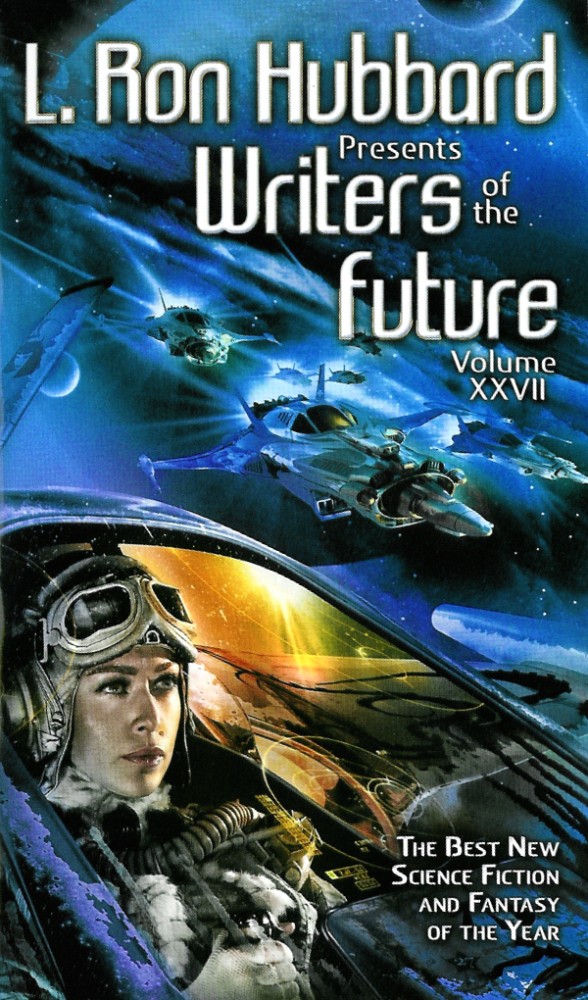

 Yes, I know I am a year behind but I bought this book before 25 became available AND this edition can be found in the stores today. So for readers that like to browse and choose the reading material from books on a shelf, this review is for you.
 Jordan Lapp is a writer who has won the first prize of the prestigious